


The people's congress system is China's fundamental political system. The Constitution of the PRC provides that state power belongs to the people. The NPC and local people's congresses at all levels are organs representing the people in exercising state power. The First NPC in 1954 marked the establishment of the system.
The people's congresses have four main functions and powers: legislation, supervision, appointment and removal of officials, and making decisions on major issues. These functions are a major reflection of the way the Chinese people exercise their power as masters of the state through the people's congress system. To persist, improve and develop the system is an important part of the building of political democracy in China. Since the Third Session of the 11th Plenary Session of the Communist Party of China (CPC) in 1978, the people's congress system has seen constant improvement and development.
The past 50 years have proved that the people's congress system accords with the national conditions of China. It not only ensures that people exercise state power in a concerted way and gives full play to their enthusiasm and initiative as masters of the state, but also creates favorable conditions for state organs to share the work and help one another in organizing the socialist construction.
Work of the 10th NPC Standing Committee in 2006
The Chinese people put into practice the scientific outlook on development in 2006 and got off to a good start in implementing the country's 11th Five-Year Program for National Economic and Social Development. In the year, the Standing Committee followed the guidelines set out at the Fourth Session of the 10th NPC in diligently carrying out its duties centered on the overall work of the Party and the government, making further contributions to the building of a moderately prosperous society in all respects and the building of a harmonious socialist society.
Works Related to Deputies
During the Fourth Session of the 10th NPC in 2006, the deputies submitted 1,006 motions. Ten laws were deliberated and passed by the Standing Committee related to 100 of the motions, seven draft laws related to 26 motions were submitted to the Standing Committee for deliberation, and another 51 legislative projects related to 358 motions were included in the schedule for legislation work or the annual plan. Some other motions were transferred to the State Council for study in order to formulate relevant administrative regulations. Explanations were made about the motions that called for legislation in areas where conditions are not yet ripe for this.
During the Fourth Session of the 10th NPC, the deputies also submitted 6,511 suggestions, and these were referred to 174 departments and organizations to study and deal with. With the concerted efforts of everyone involved, 1,810 or 28 percent of the problems reflected in the suggestions have already been solved or are being addressed, and solutions have been found or work plans have been drawn up for 3,148 problems, or 48 percent of the total. Both figures are higher than those for the previous year.
The number of NPC deputies invited to meetings of the Standing Committee as non-voting participants increased from 140-plus to 185, and the number of deputies who participated in inspections in compliance with the law and in legislation-related investigations rose from nearly 400 to more than 500. Agendas, relevant documents and reference materials for the meetings were sent to the non-voting participants in a timely manner. The Standing Committee held a forum for invited deputies before it met to brief them on its work, explain bills and listen to the comments and suggestions of the deputies concerning its work.
Organization and services for deputies' investigations and studies on special topics were improved. Under the unified arrangements of standing committees of provincial people's congresses, deputies were free to form investigating groups on their own and chose their topics based on actual conditions. This better focused their investigations and studies and made them much more effective. All this played an important role in raising the quality of the deputies' motions and suggestions.
Legislation
The Standing Committee deliberated and approved 24 draft laws and decisions on legal issues, 14 of which were passed and five were submitted to the annual full session in March 2007 for deliberation and approval. The 14 passed laws and decisions included: the Law on Oversight, the Law on Quality in Safety of Farm Produce, the Passport Law, Amendment of the Criminal Law (sixth), the Law on Compulsory Education (revised), the Corporate Bankruptcy Law, the Law on Individual Joint Ventures (revised), the Law Against Money Laundering, the Law on Special Cooperatives Established by Individual Farmers, the Law on the Protection of Minors (revised), the Decision on Revising the Law on Banking Regulation, the Decision on Revising the Organic Law of People's Courts, the Decision on Empowering the Hong Kong Special Administrative Region to Exercise Administration Over the Port Area of the Shenzhen Bay on the Hong Kong Part and the Decision on Strengthening Legal Publicity and Education. The five laws and decisions submitted to the Fifth Session of the 10th NPC were: the Property Right Law, the Corporate Income Tax Law, the Decision on Issues Concerning the Number of Deputies to the 11th NPC, the Measures for the Election of Deputies to the 11th NPC in the Hong Kong Special Administrative Region and the Measures for the Election of Deputies to the 11th NPC in the Macao Special Administrative Region.
 |
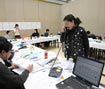
The Chinese people exercise state power through the people's congress system at all levels. Pictured is a legislative hearing for amending the law of personal income tax held by the Standing Committee of the National People's Congress.
The Law on Oversight, which is strongly political in nature, is related to the country's political system and system of government. Formulation of the law was one of the major legislative acts of the NPC. Work began on this law at the Sixth NPC (June 1983-March 1988) and continued for the next two decades. The promulgation and implementation of the law is of great significance for standing committees of people's congresses at all levels in the lawful exercise of their oversight functions and powers, improving the oversight mechanism, strengthening and improving oversight work, making oversight more effective, and giving more play to the characteristics and strength of the system of people's congresses.
Deliberation and approval of the Property Right Law and the Corporate Income Tax Law were important agendas of the annual full session of the 10th NPC in March 2007.
In 2006, the Standing Committee made great efforts to make legislative work more scientific and democratic and raised the quality of legislation.
Supervisory Role
There were two prominent features to the oversight work of the Standing Committee in 2006. First, the Standing Committee focused its oversight on the major issues that have a bearing on the overall interests of reform, development and stability, elicit widespread concern in society, or affect social harmony. Second, the Standing Committee carried out thorough oversight through various means including the hearing and deliberation of work reports on special subjects as well as investigations of compliance with the law. Throughout the year, the Standing Committee heard, deliberated and approved eight work reports on special subjects from the State Council, the Supreme People's Court and the Supreme People's Procuratorate, and investigated the implementation of 12 laws.
In 2006, the Standing Committee centered its oversight work on efforts to build a new socialist countryside, on efforts to make China an innovative country, on building a conservation-minded and environment-friendly society and on promoting judicial fairness. It established groups to investigate compliance with the Law on Ethnic Regional Autonomy and the Law on the Protection of the Rights and Interests of Returned Overseas Chinese and Their Relatives. The Standing Committee also strengthened supervision over the state budget and economic work. It heard, deliberated and approved the report on the final state accounts of the Central Government, the auditing work report and the report on the implementation of the state development plan, as well as the report of the State Council on reforming state-owned commercial banks to transform them into joint-stock companies and on deepening reform of the financial system.
The Standing Committee carefully handled the suggestions of individuals and organizations and conducted focused inspections on its own initiative to safeguard consistency in the country's legal system. It paid close attention to petitions submitted through letters and visits from the general public. More than 150,000 letters were received from the public in 2006 and over 75,000 visits were recorded. For problems that occurred frequently, such as legal and judicial issues, land expropriation and requisition, relocation of people to build reservoirs, housing demolition, medical care, education, social security and environmental protection, the Standing Committee increased efforts to refer problems to the concerned departments and organizations for them to address and followed up on how they were handled, urged these departments and organizations to handle problems in accordance with the law and government policy, and helped solve some of the problems reflected in the letters and visits, thus playing a positive role in solving problems in society and promoting social harmony.
External Relations
In 2006, the Standing Committee received 90 delegations from 56 countries, and missions headed by members of its Chairpersons' Council visited 30 countries and regions.
On the basis of the mechanisms it has established for regular exchanges with the parliaments or congresses of eight countries, including Russia and the United States, as well as with the European Parliament, over the previous few years, the Standing Committee set up mechanisms at different levels for exchanges with parliaments or congresses of South Africa, the Republic of Korea, India, Australia, Egypt, Brazil and Chile as well as the Japanese Diet. A basic pattern for such mechanisms has been established.
The cooperation council composed of members of the Standing Committee and the Russian Federation Council and the cooperation council composed of members of the Standing Committee and the State Duma of Russia held their first meetings in 2006. A fresh round of talks was held separately by members of the Standing Committee with members of the U.S. Senate and House of Representatives. The NPC held its 23rd regular meeting with the European Parliament. The cooperation council composed of members of the Standing Committee and the Japanese House of Councilors held its second meeting. The NPC's exchanges with the parliaments of France, Britain, Canada and other countries proceeded smoothly.
The Standing Committee participated actively in multilateral activities of international and regional parliamentary organizations, such as the Inter-Parliamentary Union, the Asian Parliament Assembly, the Asia Pacific Parliamentary Forum, the Latin American Parliament, the ASEAN Inter-Parliamentary Organization and the Parliamentary Assembly of the Pacific Islands Forum. The Chinese delegation attended the first speakers' meeting of member states of the Shanghai Cooperation Organization, held in Moscow in May 2006, and raised three proposals for cooperation among parliaments under the framework of the Shanghai Cooperation Organization, focusing on promoting collaboration among all member states in practical issues in all areas including the fight against violent terrorist forces, ethnic separatist forces and religious extremist forces, and adopting a variety of flexible means for cooperation at regular or irregular intervals. The proposals received widespread approval from the participants and exerted a positive influence on the development of multilateral cooperation among parliaments and congresses.
In 2006, the Standing Committee ratified 18 treaties and agreements China concluded with foreign states and approved the country's accession into three international conventions.
The Fifth Session of the 10th NPC
The Fifth Session of the 10th NPC was held in Beijing on March 5-16, 2007, with 2,978 deputies in attendance. The session approved the Report on the Work of the Government, the Work Report of the NPC Standing Committee, the Work Report of the Supreme People's Court and the Work Report of the Supreme People's Procuratorate. Lawmakers also deliberated and endorsed the Report on the Implementation of the 2006 Plan for National Economic and Social Development and the Draft 2007 Plan for National Economic and Social Development, and the Report on the Implementation of the Central and Local Budgets for 2006 and the Draft Central and Local Budgets for 2007.
 |
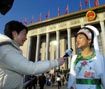
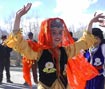
Deputies to the National People's Congress are broadly representative. Pictured is an ethnic minority NPC deputy in an interview.
The session also approved the Property Right Law, the Corporate Income Tax Law, the Decision on Issues Concerning the Number of Deputies to the 11th NPC, the Measures for the Election of Deputies to the 11th NPC in the Hong Kong Special Administrative Region and the Measures for the Election of Deputies to the 11th NPC in the Macao Special Administrative Region.
The presidium of the meeting received 796 motions from deputies and delegations to the Fifth Session of the 10th NPC and transferred them to special committees of the 10th NPC for studies.