





Multi-party cooperation and political consultation under the leadership of the CPC constitute the basic party system in China. It was jointly created and developed by the CPC and other democratic parties in the long-standing process of China's revolution, construction and reform. The system, which was conceived in the democratic revolution period and was established after the founding of the PRC in 1949, has made great headway after the Third Plenary Session of the 11th CPC Central Committee held in 1978.
China's party system is distinct from the multi-party or two-party systems in Western capitalist countries, as well as the one-party system in a few countries. Its evident features are as follows: The CPC acts as the ruling party while, under the leadership of the CPC, other parties participate in the discussion and management of state affairs, in cooperation with the CPC. Cooperative relations between the CPC and other parties are based on the principle of "long-term coexistence and mutual supervision, treating each other with full sincerity and sharing weal or woe."
The Constitution of the PRC is the basic code of conduct for the CPC and the other parties. Within the scope of constitutional rights and obligations, these parties enjoy political freedom, organizational independence and equal legal status. The Constitution provides that the system of multi-party cooperation and political consultation under the leadership of the CPC will long exist and develop.
The multi-party cooperation in China is mainly carried out in six forms.
First, political consultation between the CPC and other parties. Before the CPC Central Committee makes major decisions, it usually sponsors forums and symposiums where CPC leaders can introduce relevant situations to leaders of the other parties and representatives of personages without party affiliation, as well as discuss state affairs with them and listen to their opinions.
Second, giving play to the role representatives of democratic parties and personages without party affiliation in people's congresses at all levels. Members of these parties and personages without party affiliation now take an appropriate percentage of seats in the NPC and its Standing Committee and special committees. Deputies to people's congresses at different levels, who are elected from people outside the CPC, total 140,000. Through taking part in activities of people's congresses, they convey people's opinions, participate in formulation of major decisions and legislations, and supervise the government.
Third, recommending qualified members of democratic parties and non-party personnel to assume leading posts in government and judicial organs at all levels. At present, more than 8,000 people outside the CPC hold leading posts at and above the county magistrate-rank in governments and law-enforcement organs at all levels. Invested with real power, they and their colleagues with CPC membership cooperate with each other closely and frankly, making important contribution at their respective posts.
Fourth, strengthening the participation of democratic parties in the work of the CPPCC. These parties participate in the CPPCC in the name of political groups, and, on this basis, air opinions, raise proposals and participate in discussion and administration of state affairs. Members of these parties and non-party people are the majority in members of CPPCC committees at various levels and their standing committees and leadership, exceeding 270,000 in number for the moment. They account for 60.1 percent of members of the 10th CPPCC National Committee, 65.2 percent of its Standing Committee members and 13 of its 24 vice chairpersons.
Fifth, encouraging non-CPC personnel to scrutinize the CPC and the government through multiple channels and in multiple forms. A complaint reporting system has been established within all democratic parties and the All-China Federation of Industry and Commerce. In addition, a lot of people outside the CPC have been invited to serve as supervisors, inspectors, auditors, education inspectors, taxation inspectors and land and resources inspectors, or to participate in the investigation of major crimes and taxation inspections.
Sixth, supporting democratic parties to participate in practices of reform, opening up and socialist modernization.
The political advantages of the system of multi-party cooperation and political consultation under the leadership of the CPC lie in the fact that it can both achieve wide democratic participation, pool the wisdom of democratic parties, mass organizations and people of all walks of life and promote the scientific and democratic decision-making of the party in power and governments at all levels, and realize centralization and unity and draw up unified plans with due consideration given to the interests of different sections of the people. Moreover, it can avoid both the problem of insufficient supervision common under one-party rule, and political chaos and a lack of stability and unity that may be caused by disputes and strife of several parties.
In February 2005, the CPC promulgated the Opinions of the CPC Central Committee on Further Strengthening the Building of the System of Multi-Party Cooperation and Political Consultation Under the Leadership of the CPC, which, on the basis of summing up historical experience and successful operations in multi-party cooperation and political consultation, further clarifies the principles, contents, ways and procedures of the system of multi-party cooperation and political consultation, and points the direction for improving the socialist political party system with Chinese characteristics.
The Chinese People's Political Consultative Conference
The First Session of the Chinese People's Political Consultative Conference (CPPCC) was held in Beiping (now Beijing) on September 21-30, 1949. From then on, 10 CPPCC national committees have been installed. The CPPCC is an organization of the patriotic united front of the Chinese people. It is also an important organ of multi-party cooperation and political consultation under the leadership of the CPC, and an important instrument of democracy in the nation's political life.
According to its current statute, the CPPCC National Committee is composed of members of the CPC and other parties, personages without party affiliation, representatives of people's organizations, ethnic minorities and all walks of life, representatives of compatriots of the Hong Kong Special Administrative Region, the Macao Special Administrative Region and Taiwan, as well as of returned overseas Chinese and other specially invited people, who are divided into several circles. The CPPCC establishes a national committee, a standing committee and nine special committees at the central level and local committees in various localities. The nine central-level special committees include the Committee for Handling Proposals, the Economic Affairs Committee, the Population, Resources and Environment Committee, the Education, Science, Culture, Health and Sports Committee, the Social and Legal Affairs Committee, the Ethnic and Religious Affairs Committee, the Cultural and Historical Data Committee, the Committee for Liaison with Hong Kong, Macao, Taiwan and Overseas Chinese and the Foreign Affairs Committee. The CPPCC National Committee, which has one chairperson, a number of vice chairpersons and one secretary general, is elected for a term of five years and holds a plenary session each year.
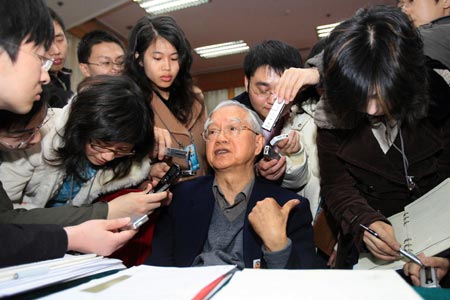 |
Chinese economist Wu Jinglian, a member of the National Committee of the Chinese People's Political Consultative Conference, answers questions about China's hot economic issues at an annual session of the highest advisory body of China.
The CPPCC exercises the functions of political consultation, democratic supervision, and participating in the administration and discussion of state affairs. The CPC and governments at all levels consult the CPPCC on fundamental policies and important issues in political, economic, cultural and social affairs before a decision is adopted and during the implementation of such decisions, so as to heed and canvass a wide range of opinions. This is a key link for the CPC and the governments at all levels to ensure that decision-making is scientific and democratic.
Renmin Zhengxie Bao (The CPPCC News), created in 1983, is the organ of the CPPCC National Committee.
Successive CPPCC National Committees
|
Term |
Opening |
Membership |
Chairperson |
|
First |
Sep. 1949 |
180 |
Mao Zedong |
|
Second |
Dec. 1954 |
559 |
Zhou Enlai (Honorary Chairman Mao Zedong) |
|
Third |
Apr. 1959 |
1,071 |
Zhou Enlai (Honorary Chairman Mao Zedong) |
|
Fourth |
Dec. 1964 |
1,199 |
Zhou Enlai (Honorary Chairman Mao Zedong) |
|
Fifth |
Feb. 1978 |
1,988 |
Deng Xiaoping |
|
Sixth |
Jun. 1983 |
2,039 |
Deng Yingchao (female) |
|
Seventh |
Mar. 1988 |
2,081 |
Li Xiannian |
|
Eighth |
Mar. 1993 |
2,093 |
Li Ruihuan |
|
Ninth |
Mar. 1998 |
2,196 |
Li Ruihuan |
|
10th |
Mar. 2003 |
2,238 |
Jia Qinglin |
10th CPPCC National Committee
Chairman: Jia Qinglin
Vice Chairpersons: Wang Zhongyu, Liao Hui, Liu Yandong (female), Ngapoi Ngawang Jigme (Tibetan), Ba Jin (dead), Pagbalha Geleg Namgyai (Tibetan), Li Guixian, Zhang Siqing, Ding Guangxun, Henry Fok Ying-tung (dead), Ma Man-kei, Bai Lichen (Hui), Luo Haocai, Zhang Kehui, Zhou Tienong, Hao Jianxiu (female), Chen Kuiyuan, Abdul'ahat Abdurixit (Uygur), Xu Kuangdi, Li Zhaozhuo (Zhuang), Huang Mengfu, Wang Xuan (dead), Zhang Huaixi, Li Meng, Tung Chee-hwa, Zhang Meiying (female) and Zhang Rongming (female)
The Fifth Session of the 10th CPPCC National Committee
On March 3-15, 2007, the Fifth Session of the 10th CPPCC National Committee was held in Beijing. The meeting deliberated and approved the Work Report of the Standing Committee of the 10th National Committee delivered by Chairman Jia Qinglin and the Report of the Standing Committee on the Handling of Proposals Since the Fourth Session of the 10th National Committee delivered by Vice Chairman Huang Mengfu. CPPCC National Committee members also listened to and expressed support to the Report on the Work of the Government delivered by Premier Wen Jiabao, the Work Report of the Supreme People's Court and the Work Report of the Supreme People's Procuratorate.
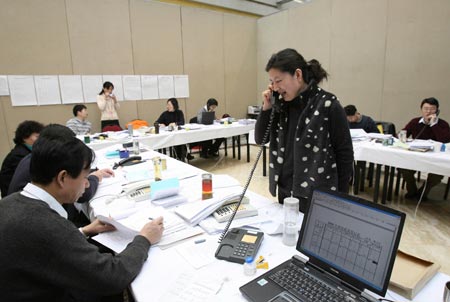 |
Staff workers with the National Committee of the Chinese People’s Political Consultative Conference collect proposals at an annual session of the highest advisory body of China.
During the session, the Committee for Handling Proposals received a total of 4,516 proposals, submitted by 2,023 CPPCC National Committee members or 89.24 percent of the total membership. After examination, 4,245 proposals were put on record. Of the accepted proposals, 1,938 proposals focused on economic construction, making up 45.65 percent of the total; those on scientific, educational, cultural, medical and sports issues totaled 1,160, accounting for 27.33 percent; and those on political and legislative affairs and social security amounted to 1,147, representing a share of 27.02 percent. After the closing of the session, the National Committee transferred the proposals it received to 169 relevant departments and organizations for handling.