






At the end of 2006, the population in China totaled 1.31448 billion, a year-on-year increase of 6.92 million. Altogether 15.84 million babies were born and 8.92 million people deceased in the year, with the birth rate of 12.09 per thousand and the death rate of 6.81 per thousand. The natural growth rate of population was 5.28 per thousand in 2006.
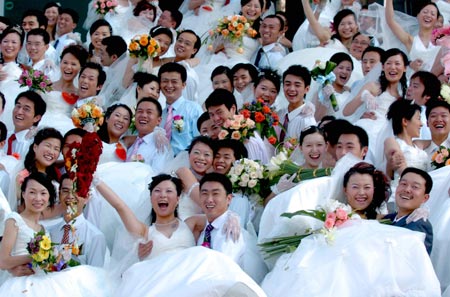 |
China is expecting the third population peak by 2050. Pictured is a group wedding in Fuzhou, Fujian Province.
China has 56 ethnic groups. These groups vary greatly in the number of population. Of them, the Han ethnic group has the largest population, while the other 55 ethnic groups, with smaller populations, are customarily called "ethnic minorities."
Population And Its Structure in 2006
|
Index |
Year-end figure (10,000) |
Proportion (%) |
|
Total population Urban Rural Male Female 0-14 15-59 60 and above 65 and above |
131448 57706 73742 67728 63720 25961 90586 14901 10419 |
100.0 43.9 56.1 51.5 48.5 19.8 68.9 11.3 7.9 |
According to the 1-percent national population sample census in 2005, the 55 ethnic minority groups had 123.33 million people, making up 9.44 percent of the national total. Of them, 18 ethnic minority groups have more than 1 million population. The Zhuang is the largest of them, with a population of nearly 16.1788 million, and the Lhoba is the smallest, having a population of only 3,000 or so.
The Hans are distributed all over China, though living in compact communities in the Yellow, Yangtze and Pearl river valleys and in the Songliao Plain. The ethnic minorities inhabit 60 percent of the Chinese territory, despite their small population. Over the ages, the Han people have established extensive political and economic ties and cultural exchanges with various ethnic minorities and they have formed an interdependent relationship for common development. People of all ethnic groups in China have made important contributions to the creation of a unified multiethnic country and the creation of the time-honored, splendid Chinese civilization, as well as Chinese historical development and progress.
Basic Facts of Various Ethnic Groups
Han: With a population of nearly 1.2 billion, it forms the main body of the Chinese nation. The Han people inhabit most regions in China, but mainly live in the Yellow, Yangtze and Pearl river valleys. The Hanyu or Han Chinese is the common language of both the Hans and the majority of ethnic minorities.
Mongolian: Comprising 5.8139 million people, the former nomads now lead a settled life. Altogether 3.9952 million, or 68.7 percent of the total, live in Inner Mongolia Autonomous Region. Besides, Hebei, Liaoning, Jilin, Heilongjiang and Xinjiang all have Mongolian dwellers with a population of more than 100,000. The Mongolian people have their own spoken and written language.
Hui: The Hui is an Islamic group with a population of 9.8168 million. Among them, a total of 1.8625 million, or 18.9 percent, live in compact communities in Ningxia Hui Autonomous Region. Provinces, autonomous regions and municipalities such as Beijing, Hebei, Inner Mongolia, Liaoning, Anhui, Shandong, Henan, Yunnan and Xinjiang also have a Hui population of more than 200,000.
Tibetan: Believing in Tibetan Buddhism, the group has a population of around 5.416 million, with 2.4272 million living in Tibet Autonomous Region. Also distributed in Sichuan, Gansu, Qinghai and Yunnan provinces, the Tibetan people have their own spoken and written language.
Uygur: The Uygur is an Islamic group with a population of more than 8.3984 million. A total of 8.3456 million, or 99.36 percent of China's Uygur population, live in Xinjiang Uygur Autonomous Region. The Uygur people use their own spoken and written language.
Miao: The group has a population of 8.9401 million, of which 48.1 percent lives in Guizhou Province. The Miao people also live in compact communities in Yunnan, Hunan, Hubei, Guangdong, Sichuan provinces, Chongqing municipality and Guangxi Zhuang Autonomous Region, each with a population of more than 100,000. They have their own spoken and written language.
Yi: It is one of the oldest ethnic groups in China, with a population of 7.7623 million. The Yi people are mainly distributed in Yunnan, Sichuan and Guizhou provinces and in the northwest of Guangxi Zhuang Autonomous Region. They have their own spoken and written language.
Zhuang: The largest ethnic minority group in China has a population of nearly 16.1788 million, with 14.2071 million, or 87.81 percent of the all, living in Guangxi Zhuang Autonomous Region. In addition, each province of Yunnan and Guangdong has a Zhuang population of more than 100,000, and each of Guizhou, Hainan, Hunan and Hebei provinces has more than 10,000 Zhuang people. Besides their own spoken and written language, the Zhuang people also use the Han Chinese script.
Bouyei: The group has a population of 2.9715 million, with the majority of them inhabiting south Guizhou Province and the rest living scattered in Yunnan and Sichuan provinces and Guangxi Zhuang Autonomous Region. Besides their own spoken and written language, the Bouyei people also use the Han Chinese script.
Korean: The group has 1.9238 million people. The Koreans mainly live in the Yanbian Korean Autonomous Prefecture, Jilin Province, though they can also be found in Heilongjiang and Liaoning provinces and Inner Mongolia Autonomous Region. They have their own spoken and written language.
Manchu: The second largest ethnic minority group in China has a population of 10.6823 million, mainly living in northeast China. Liaoning Province has the largest number of the Manchu people who also live in small groups in some large and medium-sized cities.
Dong: The group comprises 2.9603 million people, who are mainly distributed in the contiguous areas of Guizhou and Hunan provinces and Guangxi Zhuang Autonomous Region. Besides their own spoken and written language, the Dong people also use the Han Chinese script.
Yao: The group comprises more than 2.6374 million people. Mainly distributed in Guangxi Zhuang Autonomous Region and Hunan, Yunnan, Guangdong, Guizhou and Jiangxi provinces, the Yao people generally use their own spoken language and the Han Chinese script.
Bai: The group comprises 1.8581 million people. Believing in Buddhism, most of the Bai people inhabit the Dali Bai Autonomous Prefecture, Yunnan Province, with small groups living in Guizhou, Sichuan and Hunan provinces. They generally use their own spoken language and the Han Chinese script.
Tujia: The group comprises more than 8.0281 million people, mainly living in the Xiangxi Tujia-Miao Autonomous Prefecture of Hunan Province and the Enshi Tujia-Miao Autonomous Prefecture of Hubei Province. The Tujia people are also distributed in Sichuan and Guizhou provinces. They generally use their own spoken language and the Han Chinese script.
Hani: With a population of 1.4397 million, the Hani is an ethnic group living and engaged in farming in mountains between the Honghe and Lancangjiang rivers in the south of Yunnan Province. The Hani people have their own spoken and written language.
Kazak: The Kazak is an Islamic group comprising more than 1.2505 million people. Mainly living in Xinjiang Uygur Autonomous Region, the Kazak people are also distributed in small groups in Gansu and Qinghai provinces. They have their own spoken and written language.
Dai: The group comprises 1.159 million people inhabiting Xishuangbanna and some other areas in Yunnan Province. Most of the Dai people are believers in Hinayana (the Little Vehicle of Salvation) of Buddhism. Besides their own spoken and written language, they also use the Han Chinese script.
Li: The group comprises 1.2478 million people, mainly distributed in central and southern parts of Hainan Province. Besides their own spoken and written language, the Li people also use the Han Chinese script.
Lisu: With a population of 634,900, the Lisu people live in compact communities in the northern part of Yunnan Province and some areas at the junction of Yunnan and Sichuan provinces. The group has its own spoken and written language.
Va: The group comprises 396,600 people mainly distributed in southwest Yunnan Province. The Va people have their own spoken and written language.
She: The group comprises 709,600 people, with the majority living in the mountainous areas of southeast China's Fujian and Zhejiang provinces and the rest distributed in Jiangxi, Guangdong and Anhui provinces. The She people use the Han Chinese.
Gaoshan: With a population of 400,000, the Gaoshan is the chief ethnic minority group in Taiwan. The majority of the Gaoshan people live in central mountains and eastern plains on the island, and a small group inhabits Fujian and Zhejiang provinces on China's mainland. The Gaoshan people have their own spoken language.
Lahu: With a population of 453,700, the Lahu ethnic group mainly lives in the Lancangjiang River Valley in southwest Yunnan Province. The Lahu people have their own spoken and written language.
Shui: The group comprises 406,900 people, the majority of whom live in southeast Guizhou Province and a small group in west Guangxi Zhuang Autonomous Region. The Shui people generally use their own spoken language and the Han Chinese script.
Naxi: With a population of 308,800, the group lives mainly in Lijiang Prefecture, Yunnan Province. The Dongba Script created by the Naxi people more than 1,000 years ago is now the only well-preserved pictographic writing in the world. The Naxi people generally use their own spoken language and the Han Chinese script.
Dongxiang: With a population of 513,800, the Dongxiang ethnic group lives in compact communities in Gansu Province. The Dongxiang people can also be found in Qinghai Province and Ningxia Hui and Xinjiang Uygur autonomous regions. They generally use their own spoken language and the Han Chinese script.
Jingpo: The group comprises nearly 132,100 people. Forefathers of the Jingpo people labored and lived in the south of the Qinghai-Tibet Plateau and later moved southward. The group now inhabits some areas in west Yunnan Province in compact communities. The Jingpo people have their own spoken and written language.
Blang: With a population of over 91,900, the Blang ethnic group lives mainly in Menghai County and the surrounding areas of the Xinshuangbanna Dai Autonomous Prefecture, Yunnan Province. The Blang people generally use their own spoken language and the Han Chinese script.
Kirgiz: A group of 160,800 people, the former nomads now lead a settled life, inhabiting mainly southwest Xinjiang Uygur Autonomous Region. The Kirgiz people have their own spoken and written language.
Tu: Living mainly in the eastern part of Qinghai Province, the Tu ethnic group has a population of 241,200. The Tu people generally use their own spoken language and the Han Chinese script.
Daur: The group comprises more than 132,400 people, mainly distributed along the banks of the Nenjiang River, northeast China, and in Tacheng Prefecture, Xinjiang Uygur Autonomous Region. The Daur people generally use their own spoken language and the Han Chinese script.
Mulam: The group comprises 207,400 people, with 90 percent of them living in the mountainous Luocheng Mulam Autonomous County, north Guangxi Zhuang Autonomous Region. The Mulam people generally use their own spoken language and the Han Chinese script.
Qiang: The Qiang is an old ethnic group now having a population of 306,100. Records of the group can be found on unearthed bones and tortoise shells with inscriptions of the Yin Dynasty over 3,000 years ago. Today, the Qiang people live in compact communities in Maowen County of the Aba Tibetan-Qiang Autonomous Prefecture, Sichuan Province. They generally use their own spoken language and the Han Chinese script.
Salar: Mainly inhabiting Qinghai and Gansu provinces and Xinjiang Uygur Autonomous Region, the group has a population of 104,500. The Salar people generally use their own spoken language and the Han Chinese script.
Tajik: With a population of 41,000, the group inhabits the Pamirs Plateau in southwest Xinjiang Uygur Autonomous Region. The Tajik people are mainly engaged in animal husbandry as well as farming, and generally use their own spoken language and the Uygur script.
Maonan: The group comprises 107,200 people mainly distributed in Huanjiang County in the northwest of Guangxi Zhuang Autonomous Region. The Maonam people generally use their own spoken language and the Han Chinese script.
Gelao: The group comprises 579,400 people, with the majority living in the Wuchuan Gelao-Miao Autonomous County and the Daozhen Gelao-Miao Autonomous County, Guizhou Province, and the rest scattered in Yunnan Province and Guangxi Zhuang Autonomous Region. The Gelao people generally use their own spoken language and the Han Chinese script.
Xibe: The group comprises more than 188,800 people mainly distributed in the Qapqal Xibe Autonomous County of Ili Prefecture, Xinjiang Uygur Autonomous Region, and in Liaoning, Jilin and Heilongjiang provinces. The Xibe people have their own spoken and written language.
Achang: The group comprises more than 33,900 people living in compact communities in Longchuan and Lianghe counties in the Dehong Dai-Jingpo Autonomous Prefecture, Yunnan Province. The Achang people normally live in villages separate from those of the Dai and Han peoples. They use their own spoken language and the Han Chinese script.
Pumi: With a population of over 33,600, the group lives mainly in the northwestern mountains of Yunnan Province. Forefathers of the Pumi people moved to Yunnan from the remote northwest, making the group one of the ethnic minorities migrating the longest distance. The Pumi people use their own spoken language and the Han Chinese script.
Nu: The group comprises more than 28,800 people living together with other ethnic groups along the banks of the Nujiang River in Yunnan Province. The Nu people use their own spoken language and the Han Chinese script.
Ozbek: With a population of 12,400, the group lives harmoniously with Uygur and Kazak ethnic groups in the southern and northern parts of Xinjiang Uygur Autonomous Region. The Ozbek people have their own spoken and written language.
Russian: The group comprises some 15,600 people, with the majority living in Ili, Tacheng, Altay and Urumqi, Xinjiang Uygur Autonomous Region, and the rest scattered in Heilongjiang Province and Inner Mongolia Autonomous Region. The Russian people have their own spoken and written language.
Ewenki: The group comprises 30,500 people mainly distributed in Hulun Buir League, Inner Mongolia Autonomous Region, and in some areas of Heilongjiang Province. The Ewenki is the only ethnic group in China raising the reindeer. The Ewenki people use their own spoken language, and the Mongolian and the Han Chinese scripts.
Bonan: With a population of 16,500, the group lives in Gansu Province. Compared with others, it is a new ethnic group formed through constant association and intermarriage between the Islamic Mongols and the Hui, Han, Tibetan and Tu peoples since the Yuan Dynasty (1271-1368). The Bonan people generally use their own spoken language and the Han Chinese script.
De'ang: With a population of 17,900, the group lives in Yunnan Province. The De'ang people generally use their own spoken language and the Han Chinese script.
Yugur: The group comprises more than 13,700 people mainly distributed in the Sunan Yugur Autonomous County and Huangnibao Yugur Township of Jiuquan City, Gansu Province. The Yugur people generally use their own spoken language and the Han Chinese script.
Tatar: An Islamic group with a population of 4,900, the Tatar people live mainly in Yining, Tacheng and Urumqi, Xinjiang Uygur Autonomous Region. They have their own spoken and written language.
Lhoba: Comprising merely 3,000 people, it is the smallest ethnic minority group in China. Living in Mainling, Medog, Zayu, Lhunze and Nangxian counties and some other areas of Nyingchi Prefecture, Tibet Autonomous Region, the Lhoba people use their own spoken language and the Tibetan and the Han Chinese scripts.
Jino: With a population of 20,900, the group lives in Jino Ethnic Township of Jinghong City in the Xinshuangbanna Dai Autonomous Prefecture, Yunnan Province. The Jino people generally use their own spoken language and the Han Chinese script.
Derung: The group comprises 7,400 people inhabiting in compact communities along the banks of Dulonghe River in west Yunnan Province. The Derung people use their own spoken language and the Han Chinese script.
Oroqen: With a population of 8,200, the group lives mainly in Hulun Buir League, Inner Mongolia Autonomous Region. The Oroqen people generally use their own spoken language and the Han Chinese script.
Hezhen: The group comprises 4,600 people living along the banks of Heil ongjiang and Wusulijiang rivers in east Heilongjiang Province. The Hezhen is the only ethnic group in China mainly engaged in fishing. The Hezhen people generally use their own spoken language and the Han Chinese script.
Moinba: The group comprises 8,900 people mainly distributed in Medog and Cona counties, Tibet Autonomous Region, who use their own spoken language and the Tibetan script.
Gin: The group comprises 22,500 people living in the four natural villages of Wanwei, Shanxin, Wutou and Tanji of Fangchenggang City, south Guangxi Zhuang Autonomous Region. The Gin people use their own spoken language and the Han Chinese script.
Note: Above statistics are according to the fifth census of China's population in 2000.