Preface
I. Judicial System and Reform Process
II. Maintaining Social Fairness and Justice
III. Strengthening Human Rights Protection
IV. Enhancing Judicial Capabilities
V. Judicial Power Serving the People
Conclusion
More news about China
Back to China.org.cn
V. Judicial Power Serving the People
Putting the people first and exercising judicial power for the people are the fundamental starting point and ultimate objective of judicial work in China. In recent years, in light of new situations and requirements coming along with the rapid socioeconomic development, China has made continuous efforts in promoting the development of the grassroots judicial organs by intensifying service consciousness in judicial work, extending work platforms and improving work procedures, so as to provide more convenience for people to exercise their rights.
1. Strengthening the Development of Grassroots Judicial Organs
Most of the cases handled by the judicial bodies take place at grassroots level, and grassroots judicial institutions are the frontline platforms providing judicial services to the public. The local grassroots courts, procuratorates, public security organs and judicial administrative bodies are strengthening such agencies as people's tribunals, procuratorial offices, police stations and judicial offices to make judicial services close to the people and provide better service to them.
Strengthening the construction of grassroots people's courts. Every year grassroots people's tribunals try an average of 2.4 million cases, accounting for one-third of all cases tried by the people's courts of first instance across the country. In recent years, to facilitate litigation, local grassroots people's courts have resumed, built or improved the people's tribunals, and promoted a mechanism for people's tribunals to directly place cases on file for investigation by simplifying this procedure. Currently, China has nearly 10,000 people's tribunals, covering almost all towns or townships and urban neighborhoods. Convenient litigation offices and liaison points have been set up in remote villages and litigation liaisons are appointed. Circuit tribunals have been set up in places where there is relative concentration of population, and they are encouraged to receive and hear cases as they go the rounds so as to serve the people as best they can.
Strengthening the construction of grassroots procuratorial offices. Local grassroots people's procuratorates have established sub-offices in some major townships or towns to receive reports from the masses about offences, their complaints and petitions, to find clues to crimes involving government functionaries, to exercise legal supervision over illegal practices in litigation, to do publicity work on crime prevention and the rule of law, to participate in social security comprehensive management and safety building, and to supervise and coordinate with community correction work. So far, China's procuratorates have set up 2,758 such offices, and 9,622 other procuratorial agencies like liaison stations and work stations.
Strengthening the construction of grassroots police stations. Public security organs are promoting a community policing strategy in urban and rural areas. Now China has more than 50,000 police stations and over 170,000 sub-stations, covering all the townships, towns and neighborhoods, making police services and distribution of police forces closer to the grassroots and the public. Public security organs have remarkably improved their capabilities to prevent and crack down on crimes, control security situation and serve the people. Since 2006, cases of serious violent crimes in eight categories handled by public security organs nationwide, including murder, robbery, rape, kidnapping and personal injury, have kept going down, by 9% in 2010 from 2009, and by 10% in 2011 from 2010.
Strengthening the construction of grassroots judicial offices. In recent years, in addition to the functions of legal publicity, legal assistance, mediation guidance and grassroots legal services, the grassroots judicial offices have taken upon themselves such new functions as community correction, and settling down and rehabilitating those committing minor offences. Currently, China has more than 40,000 such offices, covering most of the country's townships or towns and urban districts. In the 2004-2011 period, the judicial offices solved 2.84 million disputes, assisted in the mediation and settlement of 46.77 million difficult and complex disputes, participated in resettlement of 2.69 million ex-convicts, and guided the handling of 1.12 million legal-assistance cases.
2. Simplifying Case-Handling Procedures
Recent years have seen a sharp rise in litigation cases. On the basis of giving comprehensive consideration to the nature and complexity of the cases, the people's courts classified the cases into complex ones and simple ones and adopted different hearing procedures for different cases, thus applying different hearing procedures to cases of different natures to optimize judicial resources and enhance litigation efficiency.
Extending the scope of application of the summary procedures for criminal cases. The Criminal Procedure Law amended in 2012 extends the scope of application of the summary procedures from cases punishable by no more than three years in jail to all criminal cases under the jurisdiction of grassroots people's courts.
Promoting the reform of small-claim litigation. To safeguard the legitimate rights and interests of the parties concerned promptly and fairly, small-claim litigations are heard using simple procedures on a trial basis in some grassroots people's courts. If both parties involved agree to use simple procedures, when the people's court hears a civil case in which the facts, rights and obligations are clear, and involves a small sum of money, the trial of first instance will be final. Based on the previous experiences, the Civil Procedure Law amended in 2012 stipulates that among the simple civil cases heard by the grassroots people's courts, if the sum of money involved is less than 30% of the annual average wage of employees in the previous year in the province (autonomous region or municipality directly under the central government) in question, then the trial of first instance will be final. This legislation affirms the reform of small-claim litigation.
Summary procedure for administrative cases. For an administrative case of first instance in which the basic facts are evident and the dispute is trivial in character, involving a small amount of property, the people's court may, on the premise of mutual agreement between the parties concerned, have a single judge try the case, simplify the litigation procedures, and conclude the case within 45 days after it is placed on the docket.
3. Establishing Multiple Dispute Resolution Mechanisms
In response to the frequently occurring conflicts and disputes in a period of rapid social development, in 2010 the legislative organ of China promulgated the Law of the People's Republic of China on Mediation, and relevant department issued Several Opinions on Establishing and Improving Conflict and Dispute Resolution Mechanisms by Linking Litigation and Non-litigation Cases and Guidelines on Encouraging the Use of Mediation to Solve Conflicts and Disputes. They encourage the development and improvement of non-litigation dispute resolution mechanisms, thus establishing multiple dispute resolution mechanisms suited to the national conditions. Provisions such as mediation should be used first and mediation agreements shall be accepted by judicial organs are added to the Civil Procedure Law amended in 2012, reaffirming the achievements in judicial reforms.
Giving play to people's mediation. People's mediation is a Chinese way for resolving non-litigation disputes. China has established people's mediation committees in village (neighborhood) committees, townships or towns (urban districts), enterprises and public institutions, as well as industries and sectors with a high frequency of occurrence of disputes. By the end of 2011, China had 811,000 people's mediation organizations and 4.336 million mediators. In 2011, a total of 8.935 million conflicts were resolved through mediation, with a 96.9% resolution rate.
Giving play to administrative mediation. Out of the volition of the parties involved, an administrative organ may mediate administrative disputes under its jurisdiction and civil disputes relating to its functions and powers, enabling the parties concerned to reach agreement through consultation on an equal footing. Such mediation is conducive to the timely and reasonable settlement of disputes.
Giving play to judicial mediation. A people's court shall, according to its functions and powers or at the request of the involved parties, mediate civil cases lodged to it and resolve disputes under the presiding of a judge. In 2011, the people's courts in China mediated 2.665 million civil cases and had 1.746 million cases withdrawn by the parties after mediation. The people's procuratorates have established and improved a mechanism to link prosecution with mediation. With respect to a minor criminal case or a civil appeal that meets certain requirements, a people's procuratorate will ask a people's mediation organization to mediate first before it makes a decision in accordance with the law on the basis of the mediation result to jointly resolve the conflict or dispute.
Strengthening conflict or dispute resolution mechanisms by linking litigation and non-litigation cases. Highlighting the role of people's mediation organizations, social groups, lawyers, experts and arbitration agencies, China endeavors to establish a "large mediation" work system that integrates people's, administrative and judicial mediation, and improves coordination among the three in terms of procedure linkage, validity confirmation and legal guidance. As for non-litigation dispute resolution mechanisms like arbitration, the people's courts respect their own rules and provide support in such aspects as evidence and property preservation, and compulsory execution.
Improving litigation procedures for cases of public prosecution involving conciliation between the parties. For some minor crimes arising from civil disputes and for negligent crimes (excluding dereliction of duty) that may be given sentences of less than seven years, when criminal suspects or defendants repent of their crimes and obtain the forgiveness of the victims through such means as compensation for losses or apologies, and the victims wish to be reconciled with the perpetrators on a voluntary basis, both parties may be reconciled. For cases in which the parties concerned reach conciliation agreements, the people's procuratorate may recommend lenient penalties to the people's courts; and for minor crimes that do not entail criminal punishment, the people's procuratorate may issue non-litigation decisions. The people's courts may give a lenient penalty to defendants in accordance with the law.
4. Reducing Litigation Costs for Parties Concerned
China has expedited the reform and improvement of its litigation fee collection system. In 2006, China promulgated the Rules on Litigation Fee Payment, and the Methods for Management of Collection of Lawyer Service Fees. These measures markedly lowered the cost of litigants, thus mitigating the difficulty of lodging a lawsuit and hiring a lawyer, while guaranteeing normal judicial work and preventing abuse of litigation rights.
Lowering litigation charges. China has clarified the payment scope concerning litigation fees, with people's courts collecting only fees for case registration and application. China has sharply adjusted the threshold, percentage and standard of fees for cases involving property, divorce and labor disputes whose occurrence is fairly frequent, resulting in a great reduction in actual charges. Case registration fees are exempted for such cases as administrative compensation. For administrative cases, whether involving property or not, a fixed fee is collected.
Reducing and exempting litigation fees. When a party has difficulty paying a litigation fee it may apply to a people's court for judicial assistance. The state makes clear the circumstances, procedures and percentages for exemption, reduction and deferment of litigation fees, ensuring that parties with economic difficulties are able to fully exercise their litigation rights in accordance with the law.
Regulating lawyers' charges. While expanding the scope of lawyers' charges to market-adjusted prices, China continues to implement government-guided prices for service fees collected by lawyers when they act as representatives in state compensation cases and other law-suits, and rigorously standardizes the links and procedures for lawyers' charges. This effectively guarantees litigants' lawful rights and interests, as well as the state's interests while promoting the healthy development of the law profession.
Facilitating litigation. Judicial organs have generally established litigation service centers, and case registration and reception centers, and initiated and improved such systems as first inquiry responsibility, service commitment, open work and polite reception. They have improved such services as litigation guidance, search and inquiry, mediation prior to litigation, and meeting with people who report offences. They provide a suitable litigation environment for the public by opening hotlines and making use of information technology to provide online services such as case registration, serving a document, court sessions and inquiries.
5. Providing Legal Assistance
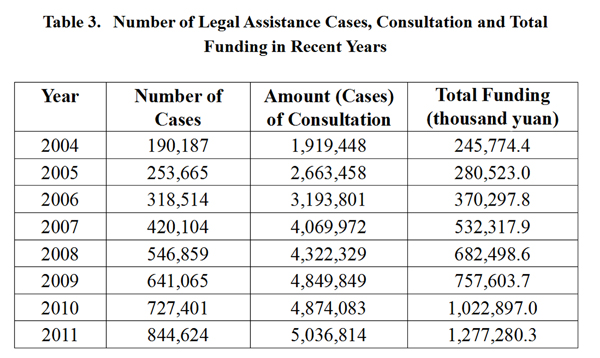
China attaches great importance to legal assistance. Since the implementation of the Regulations on Legal Assistance promulgated in 2003, China has gradually extended its coverage of legal assistance, and established and improved its funding guarantee system, providing free legal services for citizens with economic difficulties and parties to special cases of lawsuits, making it possible for more and more impoverished people to protect their legitimate rights and interests through legal assistance. In recent years, legal assistance has extended from criminal defence to areas involving people's livelihood, such as seeing a doctor, seeking employment and obtaining education; the standards of economic difficulty have been established in reference to local subsistence allowance standards; the subsidies for handling cases have been improved; and specific funding guarantee systems have been established for five special groups: migrant workers, the disabled, the elderly, minors and women. By the end of 2011, China had more than 3,600 legal-assistance agencies, 14,000 full-time legal-assistance personnel, 215,000 lawyers and 73,000 grassroots legal service personnel. A total of 28 provinces (autonomous regions and municipalities directly under the central government) have formulated local statutory regulations on legal assistance. Since 2009, funding for legal assistance has increased at an annual rate of 26.8%, reaching 1.28 billion yuan in 2011. The work of legal assistance has constantly improved along with socioeconomic advances.
6. Facilitating Channels of Communication between Judicial Organs and the Public
Judicial organs in China attach great importance to listening to the public's opinions, and make proactive efforts to guarantee the people's rights to know, participate in, be heard and supervise in terms of judicial affairs. They have established special departments to strengthen communication with members of the people's congresses and members of the Chinese People's Political Consultative Conference, and handle proposals and recommendations related to judicial work. They invite members of the democratic parties, personages without party affiliation and representatives from among the general public to act as special supervisors and procurators, people's supervisors, and specially-invited consultants to oversee their work and provide comments and advice. They have built websites and microblogs to establish mechanisms for the online expression of public opinion and opinion polls, so as to facilitate communication with the general public. They also approach the public through such activities as receiving visitors, handling petitions and hosting open days.
Preface
I. Judicial System and Reform Process
II. Maintaining Social Fairness and Justice
III. Strengthening Human Rights Protection
IV. Enhancing Judicial Capabilities
V. Judicial Power Serving the People
Conclusion