Beware of self-fulfilling debt crisis
- By He Fan & Zhu He
 0 Comment(s)
 Print
Print E-mail China.org.cn, July 24, 2016


|
|
|
The debt risk [By Jiao Haiyang/China.org.cn] |
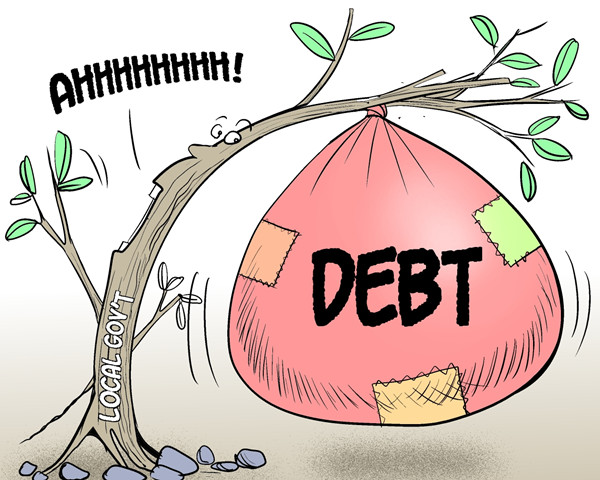
China's debt issue is becoming more of an international concern in recent years, as some international agencies believe that China's debt burden is too heavy, and could possibly trigger a debt crisis. We don't deny that challenges remain in China's economy, but we caution easy conclusions asserting an impending crisis. A clear awareness of China's current debt issue can be used to understand the formation and possible bursting point of the issue so as to prevent a self-fulfilling debt crisis.
Flaw in the standard of debt level evaluation
To begin with, a regular evaluation standard may lead to the misjudgment of China's debt issue. Currently, the academic society holds two major criteria for excessive debt levels. The first is the "Reinhart and Rogoff 90-percent threshold," which states that a country whose public debt exceeds 90 percent of its GDP will feature a growth rate far slower than those with lower debt levels.
The second is the proportion of the M2 in a country's GDP. In the discussion of China, many hold the argument that China's M2 is already 200 percent the size of its GDP, far exceeding the level of many developed countries, concluding that China has an excessive debt level.
Reinhart and Rogoff's theory is already being seriously challenged. They believe that austerity characterized by a lower debt level helps a country's economic growth, and that a government should strictly guard the 90-percent upper limit. Their conclusion served as a critical theoretical basis for Greece, when it squeezed public debt as part of its austerity policy during the European debt crisis.
But two young economists from the University of Massachusetts publically questioned the theory in 2013, arguing with an updated conclusion that there is no remarkable positive correlation between public debt levels and growth rate.
Taking the M2/GDP proportion to judge a debt level is risky, too, because the GDP only provides the added value and cannot reflect the trading volume in the middle process. In other words, the GDP-based approach would systematically underestimate the trading volume. The latest research shows that to generate each unit of GDP, the monetary demand was the biggest in the tertiary industry, then the secondary and primary industries. Therefore, the increasing proportion of the tertiary industry's output, which represents the economic restructuring in China, will consistently drive up the monetary demand.
A correct understanding of China's debt issue
Frankly speaking, the Chinese economy is faced with many challenges, and the debt issue is just one of them. But China's debt issue is not in its debt level, but in some notable structural problems.
The central government doesn't have a high debt level compared with local governments, whose debts expand more rapidly. China's government debt ratio is maintained at around 40 percent, meaning it is controllable with a large room for expansion. But corporate debts remain high, particularly in some non-financial enterprises. A calculation by the Chinese Academy of Social Sciences (CASS) showed that non-financial corporate sector's debt has reached the stunning 156 percent, 65 percent of which was from state-owned enterprises.
Such a debt structure reflects two facts. First, the central government is reluctant to adopt too many expansionary fiscal policies, still wishing that local governments will cover more expenditure. Second, the Chinese corporate sector's high debt ratio results from the old extensive growth which heavily relied on loans, and the financing difficulties for middle and small businesses.
A possible explanation is that larger state-owned enterprises get more loans than necessary from the bank, and lend the extra money to smaller businesses at a higher interest rate. This pattern shows that the Chinese economy is in a sub-healthy condition, although with no risks of an imminent crisis.
Compared with the debt ratio, liquidity should be the real concern for China. Given the relatively low government debt level, the corporate sector is where liquidity risk may take place. That is to say, enterprises fail to pay off their debts plus interest. In general, such a situation is accompanied by two phenomena, a drastic falling of profitability and new debts being issued to repay old ones.
Judging from the current situations, the profitability of China's corporate sector remains largely stable, and there are no reports that corporate funds are massively being made to patch up old debts. At the same time, corporate expenditure started to shrink in early 2016. Therefore, China is far from facing an extreme debt collapse.
Although there's no risk for an imminent debt crisis, urgency to ease the debt issue still remains. If China's debt size develops unchecked, the interest burden will augment, naturally pushing up the risk for a crisis. In light of historical and international practices, the following are common solutions for debt issues.
Economic growth is the optimal strategy. If growth can outrun debt, then there won't be any debt issue, because in the long run, debt will sooner or later be absorbed by growth. China's growth has slowed down; to put it back on track with a high growth rate, continuously increasing leverage seems the only way. But this sort of solution will only bring about debt issues and is counterproductive.
The self-fulfilling debt crisis demands attention. The above analysis shows that China's debt ratio isn't too high to bear. But if policymakers misjudge the current situation, excessively worry about China's debt level and launch a massive debt reduction, a debt crisis is more likely to happen.
A massive debt reduction is typically characterized by fiscal austerity and frugality. But the examples of the United States, Japan and Europe all showed that such practices lead to catastrophic consequences. In a recession, debt issues are inevitable, so fiscal austerity is the worst measure. Instead, stimulus packages could turn the trend.
The austerity philosophy keeps thriving because many scholars tend to think that government decisions equal family decisions, so that making ends meet is a natural principle. But this philosophy isn't necessarily correct on a macroeconomic level because, theoretically, a government's life is unlimited and bankruptcy can hardly apply to a government. History shows that national debt defaults were all, completely black swan events, both unpredictable and irremediable.
Another kind of massive debt reduction is to have all enterprises simultaneously trim their debts. But in the time of recession, a haste deleveraging may trigger a negative feedback mechanism, which in turn will bring down the economy and asset prices.
Between the best and the worst strategies do remain some compromised measures, which are capable of effects to some extent but initiate new risks.
Diluting inflation through inflation is such a method. The central bank may increase liquidity and rely on higher inflation to offset debts, but this practice, based on monetarizing debt, may result in hyperinflation.
Massive debt reorganization is another method. Debt reorganization is debt reduction in essence conducted directly or by means of debt-to-equity swap. The biggest harm of this method is that it harms the spirit of contract, since the debtors will no longer remain responsible for their actions. But further analysis will show that debt reorganization represents a punishment to those imprudent investors and is a credit risk that investors must accept. Refusal of debt reorganization will make the general tax payers pay for their debt issues, which amounts to greater unfairness.
Third, there is the option of raising the asset price to solve the debt burden. For a company, rising stock price means rising asset value, which will naturally bring down its leverage when its debt size stays unchanged. But the asset price hike won't last forever, and drastic price fluctuation may even worsen a company's debt situation.
To sum things up, China is still far from having a debt crisis outburst, but it should prevent a self-fulfilling debt crisis due to excessive concern. In detail, policymakers should keep an eye on the debt index, and make preparations before it's too late.
He Fan is the chief economist at the Chongyang Institute for Financial Studies at Renmin University of China.
Zhu He is from the Graduate School of Chinese Academy of Social Sciences.
The article was translated by Chen Boyuan. Its original version was published in Chinese.
Opinion articles reflect the views of their authors, not necessarily those of China.org.cn.


