Since the founding of the People's Republic of China, some 56 ethnic groups have been identified and confirmed by the central government, namely, the Han, Mongolian, Hui, Tibetan, Uyghur, Miao, Yi, Zhuang, Buyei, Korean, Manchu, Dong, Yao, Bai, Tujia, Hani, Kazak, Dai, Li, Lisu, Va, She, Gaoshan, Lahu, Shui, Dongxiang, Naxi, Jingpo, Kirgiz, Tu, Daur, Mulao, Qiang, Blang, Salar, Maonan, Gelao, Xibe, Achang, Pumi, Tajik, Nu, Uzbek, Russian, Ewenki, Deang, Bonan (also Bao'an), Yugur, Jing, Tatar, Derung, Oroqen, Hezhe, Monpa, Lhoba and Jino. The Han ethnic group has the largest population, while the populations of the other 55 ethnic groups are relatively small, and so the latter are customarily referred to as "ethnic minorities."
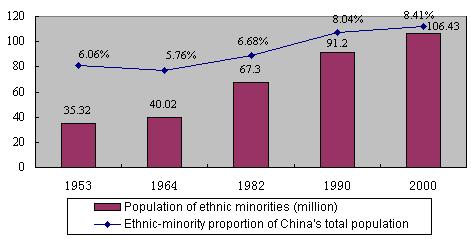
Over the past 60 years, the total population of the ethnic minorities has been on a constant increase, comprising a rising proportion in China's total population. The five national censuses that have been conducted show that the total population of ethnic minorities was 35.32 million in 1953, 6.06 percent of the total population; 40.02 million in 1964, 5.76 percent of the total; 67.30 million in 1982, 6.68 percent of the total; 91.20 million in 1990, 8.04 percent of the total; and 106.43 million in 2000, 8.41 percent of the total. The populations of the ethnic groups vary greatly from one to another. For example, the Zhuang has a population of 17 million, far more than that of the Hezhe, numbering only some 4,000.
Chart 1 Proportions of Ethnic Minorities in China's Total Population (Statistics from the Five National Censuses)
Some of China's ethnic groups inhabit vast areas, while others live in individual compact communities in small areas or live in mixture. In some cases, minority peoples can be found living in compact communities in areas inhabited mainly by Han people, while in other cases the situation is the other way round. Many minority peoples have part of their population living in one or more compact communities and the rest are scattered across the country. China's northwest and southwest are the two regions where minority peoples are most concentrated. Western China, consisting of nine provinces, three autonomous regions and one municipality directly under the central government, is home to 70 percent of China's minority population. The nine border provinces and autonomous regions are home to 60 percent of China's minority population. As China's economy and society continue to develop, the scope of minority population distribution is growing. So far, the scattered minority population across the country has topped 30 million.
In places where ethnic minorities live in compact communities, the minority populations are usually small, whereas the areas they live in are often large and rich in resources. The areas of grassland and forest, and water and natural gas reserves in areas inhabited by minority peoples account for nearly or over half of the national totals. Of China's over-22,000-km terrestrial boundary, 19,000 km traverses minority areas. In addition, the minority areas boast 85 percent of the country's state-level natural reserves, making them an important guardian of China's ecology.
The origins and development of ethnic groups in China are diverse, and have been shaped by local conditions. Some 4,000-5,000 years ago, five major ethnic groups — the Huaxia, Dongyi, Nanman, Xirong and Beidi — emerged on what is now the Chinese territory. Through continuous migration, living together, intermarriage and communication, the five ethnic groups became assimilated to each other in the course of their development, and gradually became integrated into one, from which new ethnic groups continually sprang up. Some of the latter remain distinct to this day, while others, including the once-renowned Xiongnu (Hun), Yuezhi (or Rouzhi), Xianbei, Rouran, Tuyuhun, Tujue, Dangxiang, Khitan and Saka peoples, have disappeared in the course of history due to wars, deterioration of the eco-environment or loss of identity.
Although the origins and histories of ethnic groups in China are different, the overall trend of their development was to form a unified, stable country with multiple ethnic groups. The boundaries and territory of today's China were developed by all ethnic groups in the big family of the Chinese nation during the long course of historical development. The ancestors of the Han people were the first to develop the Yellow River basin and the Central Plains; those of the Tibetan and Qiang peoples, the Qinghai-Tibet Plateau; those of the Yi and Bai peoples, southwestern China; those of the Manchu, Xibe, Ewenki and Oroqen peoples, northeastern China; those of the Xiongnu, Tujue and Mongolian peoples, the Mongolian grasslands; those of the Li people, Hainan Island; and the ancestors of the ethnic-minority peoples of Taiwan, Taiwan Island.
As early as in the pre-Qin Dynasty times before 221 BC the concepts of "country" and "unification" had taken shape in the minds of the Chinese people. In 221 BC the Qin Dynasty unified the country for the first time. It set up an administrative system of prefectures and counties, and put the regions, including today's Guangxi Zhuang Autonomous Region and Yunnan Province, where minority peoples were concentrated, under its jurisdiction. The subsequent Han Dynasty (206 BC-220 AD) further consolidated the country's unification. It set up the Protectorate of the Western Regions in today's Xinjiang Uyghur Autonomous Region, and added 17 prefectures to govern the people of all ethnic groups there. In this way, a state with a vast territory, including today's Xinjiang where the ancestors of the various peoples lived, emerged. The Qin and Han dynasties created the fundamental framework of China as a unified multi-ethnic country.
The central governments of all dynasties following the Han developed and consolidated the unified multi-ethnic country. The Tang Dynasty (618-907) established the Anxi Protector-general's Office and Beiting Protector-general's Office to manage administrative affairs in the Western Regions, including today's Xinjiang, and set up Dao, Fu and Zhou (equivalent to today's province, prefecture and county) to administer the minority peoples in central-southern and southwestern China. The Yuan Dynasty (1206-1368), established by the Mongols, appointed aboriginal officials or tuguan (hereditary posts of local administrators filled by chiefs of ethnic minorities) in the Fu and Zhou of the southern regions where minority peoples lived in compact communities. The central government set up the Commission for Buddhist and Tibetan Affairs under it and three Pacification Commissioner's Commanderies in Tibet, whereby Tibet was thenceforth brought under the effective administration of the central government of China. The Yuan also founded the Penghu Military Inspectorate for the administration of the Penghu Islands and Taiwan. Most of modern China's ethnic groups were subjects of the Yuan Dynasty. The Qing Dynasty (1644-1911), founded by the Manchus, set up the Ili Generalship and Xinjiang Province in the Western Regions, appointed Grand Minister Resident in Tibet and established the system of conferring honorific titles on two Living Buddhas — the Dalai and Panchen — by the central government. In addition, the Qing court carried out a series of political reforms in southwestern China, including the policy of gaituguiliu, i.e., appropriating the governing power of local hereditary aboriginal chieftains and setting up the system of appointment of local administrators by the central government in the minority areas. China's territory in the Qing Dynasty was basically the same as that of today.
Despite short-term separations and local divisions in Chinese history, unification has always been the mainstream and trend in the development of the country. The central governments of the various periods, whether they were founded by the Han people or minority groups, considered themselves as "orthodox reigns" of China, and regarded the establishment of a unified multi-ethnic state their highest political goal. The vast territory of China, the time-honored and splendid Chinese culture and the unified multi-ethnic country are all parts of the legacy built by all ethnic groups in China.
The long-standing existence of a unified multi-ethnic state in Chinese history greatly enhanced the economic, political and cultural exchanges among different ethnic groups, reinforced their allegiance to the central government and their identification with Chinese culture, and strengthened the cohesion force, vitality and creativity of the Chinese nation, giving rise to the unification and diversity of Chinese civilization. Traditionally, the Han people, accounting for the majority of China's total population, mainly lived in the Central Plains on the middle and lower reaches of the Yellow and Yangtze rivers, where the mild climate and flat, fertile land were suitable for farming. The minority peoples mostly lived in peripheral areas, where the abundant grasslands, deserts, forests, plateaus, mountains, hills and lakes were favorable for stock raising, hunting and fishery. The "tea-horse" and "silk-horse" trade between the Han people in the Central Plains and the surrounding minority peoples satisfied the demand of the Han people for horses for use in agriculture, transportation and military affairs while catering to the needs of minority peoples for daily necessities, thereby boosting economic complementarity and common development. The Liao (916-1125), Jin (1115-1234), Western Xia (1038-1227), and Dali (937-1253) states, established by minority peoples in various parts of China, quite clearly drew on the experience of the Han rulers of various dynasties in government system and territorial control, and absorbed many elements of the Central Plains culture. The melodies and musical instruments of the Western Regions and regions beyond the Great Wall were continuously introduced to the Central Plains, and enriched and influenced the music there. As exchanges and fusion among various ethnic groups deepened, the distribution pattern of living together and complementing each other increasingly solidified the relationship of interdependence and common development.
For over a century from the first Opium War in 1840, China suffered repeated invasions and bullying by Western powers. On the verge of national subjugation and genocide, the destiny of all ethnic groups in China was linked more closely than ever before. At the critical moment when China faced the danger of being carved up, and when the nation was on the verge of being subjugated, the Chinese people of all ethnic groups united as one, and put up the most arduous and bitter struggles against foreign invaders in order to save the country. In the 19th century, Qing troops, supported by people of all ethnic groups in Xinjiang, wiped out the invading Yakoob Beg's forces of Central Asia's Kokand Khanate and defeated the British and Russian invaders' plot to split China. Tibetan people and troops dealt a heavy blow to British invaders at the Battle of Mount Lungthur in 1888 and the Battle of Gyangtse in 1904. In the War of Resistance against Japanese Aggression after Japan invaded China on September 18, 1931, the Chinese people of all ethnic groups shared bitter hatred of the enemy, and fought dauntlessly and unflinchingly. Many anti-Japanese forces with ethnic minorities as the mainstay, such as the Hui People's Detachment and the Inner Mongolia's Daqingshan Anti-Japanese Guerrilla Contingent, made great contributions to China's victory in that war. While resisting foreign invasions, the people of all ethnic groups fought unswervingly and succeeded in safeguarding national unity and territorial integrity against acts aimed at splitting the country, including plots for the "independence of Tibet," setting up of an "East Turkestan" in Xinjiang and the creation of a puppet state of "Manchukuo" in northeast China, hatched or engineered by ethnic separatists with the support of exterior forces.
In the anti-invasion and anti-separatist struggles of modern times, the inseparable relationship among all ethnic groups in China formed in history was further consolidated. All ethnic groups were bound closer together by a common destiny of sharing weal and woe, and felt a stronger sense of responsibility as creators of Chinese history. The common cultural and psychological characteristics of all ethnic groups in China became increasingly more mature and outstanding. Today, the Chinese nation has become a name with which all ethnic groups in China identify themselves and to which they give their allegiance.