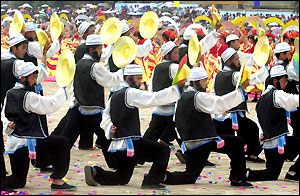
Population: 9,816,802
Major areas of distribution: Ningxia, Gansu, Henan, Hebei, Qinghai, Shandong, Yunnan, Xinjiang, Anhui, Liaoning, Heilongjiang, Jilin, Shanxi, Beijing, Tianjin
Language: Han (standard Chinese)
Religion: Islam
With a sizable population of over 9.81 million, the Hui ethnic group is one of China's largest ethnic minorities. People of Hui origin can be found in most of the counties and cities throughout the country, especially in the Ningxia Hui Autonomous Region and Gansu, Qinghai, Henan, Hebei, Shandong and Yunnan provinces and the Xinjiang Uygur Autonomous Region.
History?
The name Hui is an abbreviation for "Huihui," which first appeared in the literature of the Northern Song Dynasty (960-1127). It referred to the Huihe people (the Ouigurs) who lived in Anxi in the present-day Xinjiang and its vicinity since the Tang Dynasty (618-907). They were actually forerunners of the present-day Uygurs, who are totally different from today's Huis or Huihuis.?
During the early years of the 13th century when Mongolian troops were making their western expeditions, group after group of Islamic-oriented people from Middle Asia, as well as Persians and Arabs, either were forced to move or voluntarily migrated into China. As artisans, tradesmen, scholars, officials and religious leaders, they spread to many parts of the country and settled down mainly to livestock breeding. These people, who were also called Huis or Huihuis because their religious beliefs were identical with people in Anxi, were part of the ancestors to today's Huis.
Earlier, about the middle of the 7th century, Islamic Arabs and Persians came to China to trade and later some became permanent residents of such cities as Guangzhou, Quanzhou, Hangzhou, Yangzhou and Chang'an (today's Xi'an). These people, referred to as "fanke" (guests from outlying regions), built mosques and public cemeteries for themselves. Some married and had children who came to be known as "tusheng fanke," meaning "native-born guests from outlying regions." During the Yuan Dynasty (1271-1368), these people became part of the Huihuis, who were coming in great numbers to China from Middle Asia.
The Huihuis of today are therefore an ethnic group that finds its origins mainly with the above-mentioned two categories, which in the course of development took in people from a number of other ethnic groups including the Hans, Mongolians and Uygurs.
It is generally acknowledged that Huihui culture began mainly during the Yuan Dynasty.
Warfare and farming were the two dominant factors of this period. During their westward invasion, the Mongols turned people from Middle Asia into scouts and sent them eastward on military missions. These civilians-turned-military scouts were expected to settle down at various locations and to breed livestock while maintaining combat readiness. They founded settlements in areas in today's Gansu, Henan, Shandong, Hebei and Yunnan provinces and the Ningxia Hui Autonomous Region. They later were joined by more scouts sent from the west. As time went by they became ordinary farmers and herdsmen. Among the Islamic Middle Asians, there were a number of artisans and tradesmen. The majority of these people settled in cities and along vital communication lines, taking to handicrafts and commerce. Because of these activities a common economic life began to take shape among the Huihuis. Scattered as they were, they stuck together in relative concentration in settlements and around mosques which they built. This has been handed down as a specific feature of the distribution of Hui population in China.
The Huihui scouts and a good number of Huihui aristocrats, officials, scholars and merchants sent eastward by the Mongols were quite active in China. They exercised influence on the establishment of the Yuan Dynasty and its military, political and economic affairs. The involvement of Huihui upper-class elements in the politics of Yuan Dynasty in turn helped to promote the development of Huihuis in many fields.
Generally speaking, the social position of Huihuis during the Yuan Dynasty was higher than that of the Hans. Nevertheless, they were still subjected to the oppression of Yuan rulers. After going through the hardships of their eastward exodus, they continued to be in the hands of various Mongolian officials, functioning either as herdsmen or as government and army artisans. A fraction of them even were allocated to Mongolian aristocrats to serve as house slaves.
Being people who came to China from places where social systems, customs and habits differed from those in the east, the Huihuis began to cultivate their own national consciousness. This was caused also by their relative concentration with mosques as the center of their social activities, by their increasing economic contacts with each other, by their common political fate and their common belief in the Islamic religion.
It was during the Ming Dynasty (1368-1644) that the Huihuis began to emerge as an ethnic group.
Along with the nationwide restoration and development of the social economy in the early Ming Dynasty years, the distribution and economic status of the Huihui population underwent a drastic change. The number of Huihuis in Shaanxi and Gansu provinces increased as more and more Huihuis from other parts of the country submitted themselves to the Ming court and joined their people in farming.
Other factors contributed to their dispersion: industrial and commercial exchanges, assignment of Huihui garrison troops to various areas to open up wasteland and grow food grain, nationwide tours by Huihui officials and scholars, and especially the migration of Huihuis during peasant uprisings. They still managed, however, to maintain their tradition of concentration by setting up their own villages in the countryside or sticking together in suburban areas or along particular streets and lanes in cities. The dislocation of military scouts dating from the Yuan Dynasty had enabled the Huihuis to extricate themselves gradually from military involvement and to settle down to farming, breeding livestock, handicrafts and small-scale trading. Thus they established a new common economic life among themselves, characterized by an agricultural economy.
During the initial stage of their eastward exodus, the Huihuis used the Arab, Persian and Han languages. However, in the course of their long years living with the Hans, and especially due to the increasing number of Hans joining their ranks, they gradually spoke the Han language only, while maintaining certain Arab and Persian phrases. Huihui culture originally had been characterized by influences from the traditional culture of Western Asia and assimilation from the Han culture. However, due to the introduction of the Han language as a common language, the tendency to assimilate the Han culture became more obvious. The Huihuis began to wear clothing like the Hans. Huihui names were still used, but Han names and surnames became accepted and gradually became dominant.
Islamic religion
The Islamic religion had a deep influence on the life style of the Hui people. For instance, soon after birth, an infant was to be given a Huihui name by an ahung (imam); wedding ceremonies must be witnessed by ahungs; a deceased person must be cleaned with water, wrapped with white cloth and buried coffinless and promptly in the presence of an ahung who serves as the presider. Men were accustomed to wearing white or black brimless hats, specially during religious services, while women were seen with black, white or green scarves on their head – a habit which also derived from religious practices. The Huis never eat pork nor the blood of any animal or creature that died of itself, and they refuse to take alcohol. These taboos originated in the Koran of the Moslems. The Huis are very particular about sanitation and hygiene. Likewise, before attending religious services, they have to observe either a "minor cleaning," i.e. wash their face, mouth, nose, hands and feet, or a "major cleaning," which requires a thorough bath of the whole body.
Islam also had great impact on the political and economic systems of Hui society. "Jiaofang" or "religious community," as once practiced among the Huis, was a religious system as well as an economic system. According to the system, a mosque was to be built at each location inhabited by Huis, ranging from a dozen to several hundred households. An imam was to be invited to preside over the religious affairs of the community as well as to take responsibility over all aspects of the livelihood of its members and to collect religious levies and other taxes from them. A mosque functioned not only as a place for religious activities but also as a rendezvous where the public met to discuss matters of common interest. Religious communities, operating quite independently from each other, had thus become the basic social units for the widely dispersed Hui people.
Following the development of the Hui's agricultural economy and the increase of religious taxes levied on them, some chief imams began to build up their personal wealth. They used this to invest in land properties and engage in exploitation through land rents. The imams gradually changed themselves into landlords. Working in collaboration with secular landlords, they enjoyed comprehensive power in the religious communities, which they held tightly under their control. They left routine religious affairs of the mosques to low-rank ahungs.
The last stage of the Ming Dynasty and the early years of the Qing Dynasty (1644-1911) saw the emergence of a new system of religious aristocracy among the Huis in Hezhou (today's Linxia in Gansu Province). It came into existence as a result of intensified land concentration which exceeded the boundaries of one single religious community. This made certain imams rulers of a whole series of religious communities, turning them into Islamic aristocrats. They were deified. Kiosks were erected in their cemeteries for Moslems under their jurisdiction to worship. Their position was seen as hereditary. They enjoyed a series of feudalistic privileges as well as absolute authority over their people. The system had been in existence, however, only in some of the Hui areas in Gansu, Ningxia and Qinghai. The Huis in hinterland China had always functioned under the religious community system.
Contribution to Chinese civilization
The Huis are an industrious people. Their development and progress have been facilitated, however, by adopting the Han language and living with the Hans. Since the Yuan and Ming dynasties, large numbers of Hui peasants joined the Hans and people of other ethnic groups in reclaiming wasteland, farming and grazing in the hinterland and along border regions. Hui artisans were famous for their craftsmanship in making incense, medicine, leather and cannons, as well as in mining and smelting of ore. Hui merchants played a positive role in the economic exchanges between the hinterland and border regions and in trade contacts between China and other Asian countries. Hui scholars and scientists made outstanding contributions to China in introducing and spreading the achievements of Western Asia in astronomy, calendars, medicine and a number of other academic and cultural developments. These helped to promote the wellbeing and productive activities of the people of China as a whole. Chinese history has seen not a few outstanding Huis representing their people in the fields of politics, economy and culture.
During the Yuan Dynasty, the astronomist Jamaluddin compiled a perpetual calendar and produced seven kinds of astroscopes including the armillary sphere, the celestial globe, the terrestrial globe and the planetarium; Alaowadin and Yisimayin led the development of a mechanized way of shooting stone balls from cannons, which exercised an important bearing on military affairs in general; the architect Yehdardin learned from Han architecture and designed and led the construction of the capital of the Yuan Dynasty, which laid the foundation for the development of the city of Beijing.
During the Ming Dynasty, the Hui navigator Zheng He led massive fleets in making as many as seven visits to more than 30 Asian and African countries in 29 years. This unparalleled feat served to promote the friendship as well as economic and cultural exchanges between China and these countries. Zheng He was accompanied by Ma Huan and Ha San, also of Hui origin, who acted as his interpreters. Ma Huan gave a true account of Zheng He's visits in his book Magnificent Tours of Lands Beyond the Ocean, which is of major significance in the study of the history of communication between China and the West. Hui scholar Li Zhi (1527-1602) of Quanzhou in Fujian Province was a well-known progressive thinker in Chinese ideology history.
A number of outstanding politicians emerged among the Huis. Sayyid Ajall Sham Suddin (1211-1279) of early Yuan Dynasty was one of them. During his late years when he was serving as governor of Yunnan Province, he laid stress on agriculture, setting up special areas for peasants to reclaim wasteland and grow food grain. He advocated the harnessing of six rivers in Kunming, capital of the province; established communication posts extensively for couriers to change horses and rest; initiated teaching in Confucianism and made strong efforts in harmonizing relations among various ethnic groups. All these benefited political, economic and cultural developments in Yunnan, helping to bring closer relations between the province and the central government.
Hai Rui (1514-1587), a politician of the Ming Dynasty, was upright throughout his life. He had the courage to remonstrate with Emperor Jiajing about his fatuousness and arbitrariness that brought the nation and the people to calamity. Hai also lashed out at what he considered to be the evils of the court and inept ministers. Later during his term of office as roving inspector directly responsible to the emperor and as chief procurator of Nanjing, Hai enforced discipline, redressed mishandled cases and checked local despots in a successful attempt to boost public morale.
Since the Yuan and Ming dynasties, a great number of established Hui poets, scholars, painters and dramatists emerged. These included Sadul, Gao Kegong, Ding Henian, Ma Jin, Ding Peng and Gai Qi.
Life in the 20th century
After 1949, the Chinese government has carried out a policy of regional ethnic autonomy in Hui-populated areas. Because Huis differ from place to place, such self-autonomy has taken on various forms. Along with the Ningxia Hui Autonomous Region, the Linxia and Changji Hui Autonomous prefectures in Gansu Province and the Xinjiang Uygur Autonomous Region came into existence. Also six Hui autonomous counties were established in Zhangjiachuan of Gansu Province, Menyuan and Hualong of Qinghai Province, Yanqi of Xinjiang Uygur Autonomous Region and Dachang and Mengcun of Hebei Province. In addition, there are three other autonomous counties jointly set up by Huis with people of other ethnic groups. The right to ethnic equality and autonomy has thus been realized among the Hui people.
Officials from the Hui ethnic minority occupy an appropriate percentage in the organs of autonomy at all levels. Most leading positions in the power organs as well as leading positions in various executive departments and professional bodies are taken up by outstanding Huis. Emphasis has been laid on the training of Hui office executives, professionals and technical personnel who are competent in their work and politically progressive. All Hui officials, executives and professionals are expected to work for the advancement of industry, agriculture, animal husbandry, culture and education in accordance with local conditions. Considerable attention has been paid to the various Hui autonomous areas in terms of investment in capital construction and of manpower, material resources and technology.
Huis that live scattered across the country have the similar right to enjoy ethnic equality and to direct their own affairs. Their identity as members of an established ethnic group is respected. The political status of the Hui people has been greatly raised. An appropriate number of representatives have been elected from the Huis to take part in National People's Congresses. People's Congresses held at lower levels also have Hui representation. Hui officials work in government departments at central and local levels.
The majority of Huis believe in Islam. Their religious freedom, customs and habits are respected and guaranteed. Since 1979, the policies on ethnic minorities and religion have continued in Ningxia Hui Autonomous Region and elsewhere in the country after disruptions caused by the Cultural Revolution (1966-76). By May 1984, 1,400 mosques had been restored in Ningxia. This has made it possible for Moslems throughout the autonomous region to normalize their religious activities. An institute for the study of Islamic scriptures was established in 1982. It takes in students from among the ahungs every year. An Islam research society also was set up to conduct academic and research activities on Islam. In recent years, many young Huis have made efforts to learn Islamic classics in Arabic. Patriotic figures from Islamic circles have attended Chinese People's Political Consultative Conferences and People's Congresses at various levels. Many of them have taken up leading positions in government organs.
In Hui-populated areas, the Hui people have set up their own primary and secondary schools in their communities. Their children are able to attend schools close to their homes. They also have their own professors, engineers, doctors, scientists, writers, artists and specialists. In 1958 the first college was founded in the Ningxia Hui Autonomous Region. Today, specialized personnel of Hui and other ethnic groups are being trained at Ningxia University, Ningxia Medical College and Ningxia Institute of Agronomy.
Numerous fetters that had been forced upon Hui women over the years have been gradually removed as a result of improved education. Secondary and primary schools for female students have been established in some of the Hui-populated areas. An increasing number of Hui women are attending evening schools and schools arranged during slack winter seasons. Having acquired education at varying degrees, many of them are now skilled workers, and more are officials of various levels, as well as actresses, doctors, teachers and engineers.
Mass literary, artistic and sports activities have been spreading among the Huis, resulting in the emergence of outstanding artists and sportsmen. The skills of veteran Hui artisans in producing such traditional special handicrafts as carved ivory, cloisonne, Suzhou embroidery, carved bricks and carpets have been carried on and developed.
Medical and public health establishments have been widely set up in Hui-populated areas. Hui medical workers have been trained in large numbers. In major cities like Beijing and Tianjin, where the concentration of Huis is relatively larger, special hospitals have been provided for them. Mobile medical teams have been organized in some places to tour the countryside and mountainous areas where the Huis live. Many of the local epidemic diseases either have been put under control or eliminated. This, coupled with the improvement of economic and cultural life among the Huis, has greatly raised the general level of their health.
(China.org.cn June 21, 2005)