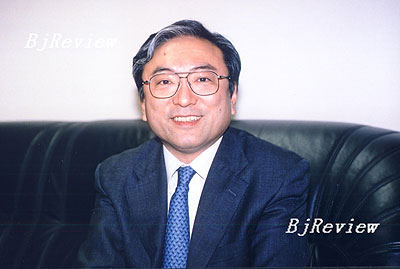
China and Japan can cooperate on a wide scope of issues, such as the organization of the Beijing Olympic Games next year and aid to Africa, said Ide Keiji, Minister of Public Relations, Press, Culture, Education and Sports and Spokesperson of the Embassy of Japan in China. He sat down with Beijing Review reporter Ding Zhitao and intern Wang Hairong to discuss his views on relations between the two countries just prior to Chinese Premier Wen Jiabao's visit to Japan.
Premier Wen's visit is very important. We wish to promote such a good atmosphere between the two countries. We expect it will provide an impetus to move each issue forward, for example, cooperation on the environment or cooperation in cultural exchanges.
"Mutual understanding is not enough. We should encourage people, especially young people, to know each other."
My understanding is that in China there are still some limits or some bias among ordinary Chinese people in their perception of Japan.
Beijing Review: Both China and Japan are confident that Premier Wen's visit to Japan will be successful. The premier once expressed his wish to make his April visit an "ice-melting" one. What preparations has Japan made to pave the way for the Chinese premier's visit? What do you expect his visit to achieve?
Ide Keiji: As you know, last October our prime minister, Mr. (Shinzo) Abe, visited Beijing. It was his first foreign visit after he assumed the post of prime minister. I think this means that Mr. Abe puts high priority on improving relations with China. So now, the Japanese Government and Japanese people are very happy to have Mr. Wen's visit to Japan. We have already extended an invitation to Chinese President Hu Jintao, and we also expect his visit to Japan. Also, we expect such mutual visits by leaders and high-ranking individuals of the two countries to increase this year and next year.
Next year the Beijing Olympic Games will be held. These Olympic Games are not only Olympic Games for China, but also for the people in Asia and in the world as a whole. The Japanese Government and Japanese people wish to contribute to the successful organization of the Games.
We have very good prospects for the future. This is the general tendency. Premier Wen's visit is very important. We wish to promote a good atmosphere between the two countries. We expect it will provide an impetus to move each issue forward, for example, cooperation on the environment or in cultural exchanges. We are preparing concrete programs to move our relations forward. This is our overall view.
Last October, Prime Minister Abe visited China. Thereafter, leaders from both sides met on several occasions. This year more frequent high-level visits will be conducted. How will these high-level visits promote bilateral ties?
The Japanese Government's position on that point is basically the same as in the past. We always work on exchanges on different levels, including the summit level, the ministerial level and among ordinary people, and in every field: politicians, business people and cultural people. This is our policy. Summit meetings and exchanges by leaders are of course very important. They give a good signal to the peoples of the two countries. The leaders are very active and very energetic in moving our relations forward. I think this is also very important.
Recently, Premier Wen mentioned establishing "strategic Chinese-Japanese relations of mutual benefit." Earlier, Prime Minister Abe also proposed developing "strategic, mutually beneficial" ties with China. How do you understand the two terms?
I think my understanding is that both countries, both governments and peoples have increasingly realized that for Japan, China is a very important country. For China, Japan is very important. We should have better relations. This is of interests to both countries. I have been working in Beijing for three years. I feel very strongly that last year and this year more and more people understand that we should have better relations. We share common challenges and tasks. We should tackle problems together if there are problems. In the Japanese Government, and in the Japanese Embassy in Beijing, we are fully aware that for Japan China is a very important country, and we should work hard to have more fruitful cooperation with China.
China and Japan have cooperated in many areas and both sides agree that this cooperation should be deepened. What will be done to carry this out?
We are neighbors. We have some common challenges and tasks, such as environmental protection and energy. We have very frequent exchanges, such as large-scale exchanges of people. Leaders' meetings should provide a good impetus for further cooperation between the two countries.
Japan has always tried to help developing countries. When China began its reform and opening-up policy, we started assistance to China. China is still a developing country, yet its role may be slowly changing. Twenty years ago, when China started its reform and opening-up policy, its economic status was still developing. Although China is still a developing country, it has started to help African and Asian countries on a massive scale. Japan is also helping African countries. We hope that in the future, Japan and China will cooperate. China's role is changing. Before, China was only a recipient of assistance and now China is a very important donor. Japan is also a donor. We can jointly help African countries. In this context, China's development is helpful to Japan. China's development gives us new possibilities to cooperate together.
It is sometimes difficult to help others. Just giving money or lending money is not good. We should help others so that the recipient country or government can eventually help itself. For that purpose, good governance is very necessary. We need some coordination, or at least discussion on how to help African countries so they will achieve good governance. It is cumbersome work. It takes lots of energy to achieve this cooperation. To help others jointly is no easy task. We need to have discussions. At this moment, this is at a primitive stage. This is a future task for us.
China and Japan are close neighbors across a narrow strip of water. We often say that the friendship between the two countries will be passed from generation to generation. What will be done to promote the friendship?
I have been in Beijing for three years. I have met Chinese people, young and old. They often say that their perception of Japan dramatically changed after their visit to Japan. I am making a snap judgment, but my understanding is that in China there are still some limits or some bias among ordinary Chinese people in their perception of Japan. We sincerely hope that Chinese people will have more opportunities to know Japan. We started some projects recently. We began some youth exchange programs last year. In 2006, the Japanese Government invited about 1,000 Chinese high school students to Japan. This year, we expanded the number to 2,000. We have had discussions with the Japan China Friendship Association in China. They have also started a program to invite Japanese students to China. We encourage the children to know each other, so that they have direct feelings about the Japanese people and Chinese people.
Mutual understanding is not enough. We should encourage people, especially young people, to know each other.
Admittedly, bilateral ties have suffered from some problems, some old, some new. What are the hurdles to the successful settlement of these issues? What measures should the two sides take to remove these obstacles?
People sometimes tend to see only problems. At this moment, Japan-China relations are basically developing quite well. Our relations are moving forward smoothly. Our relations are developing in terms of trade and investment and the exchange of people. At this moment, we do not have a trade conflict with China. For example, China has some trade conflicts with the United States and with European countries over shoes, clothing and textiles. They impose antidumping duties and so forth. Japan's economic structure has changed. We can smoothly cooperate with China. We do not impose antidumping duties on Chinese shoes and textiles. You should notice this aspect also. Of course, we are neighbors. Between neighbors conflicts may arise, which is maybe natural. We should not dramatize these issues. We should not make it too emotional. We should contain, and we should balance. This is the duty for both governments and diplomats.
This year marks the 35th anniversary of the normalization of diplomatic ties between China and Japan. What activities will be held to commemorate the event?
We are going to celebrate the 35th anniversary of bilateral ties. There are more than 200 events this year, some of which are posted on the website of the embassy.
We have several ideas. Japan will send 20,000 people to China in September and October. And we expect many Chinese people to visit Japan. The Japanese people have traditional festivals at which they dress in the traditional costume, the kimono. During the festival, which is like a carnival, 200 Japanese people will come to China to dance. Governments and private companies will organize these activities. This is an exchange between local cities. We encourage Japanese people to not only visit Beijing and Shanghai but also other cities like Dalian and Guangzhou.
Besides the 35th anniversary, there are some other anniversaries of historical events, such as the Nanjing Massacre and the Lugoqiao Incident. Are these anniversaries opportunities or challenges for bilateral ties?
We should face history squarely. We have a joint study of history. This is a very important development. If there are some areas that are not clear to historians of both countries, let the historians sit together. They should discuss and sort out the issue: On this part we have a common understanding, but on this part we need more study. We encourage historians to do such a job. Otherwise, sometimes such matters may be politicized. To politicize historical issues is quite unfortunate sometimes. If in some areas historians have different opinions, we should sit down and calmly approach these issues. We have high expectations that these people will produce positive results. These people are expected to prepare a report next year. If necessary, such work will be continued. I think this will help us to understand each other better.
As the spokesman of the Embassy of Japan in China, what are the most difficult and pleasant parts in your effort to introduce your country to China?
Some Chinese people have the misunderstanding that Japan is still a militaristic country. For Japanese who grew up after the war, it is impossible to have such a malicious intent. It is difficult for ordinary Chinese people to understand that Japan has changed after World War II. They still have a negative image of Japan. From what I understand, the difficulty for us to understand each other is that we have different political systems. It is easy for the French and Germans to understand each other because they have the same political system.
Bai Yansong (an anchorman with China Central Television (CCTV)) is working on a program about Japan. Two years ago, it was very difficult for Chinese TV people to make such a program. At a news conference, I was surprised to hear Mr. Bai saying, "The Chinese people tend to believe that they know Japan well, but in fact, the Chinese people do not know Japan. In comparison, Japanese scholars have studied China carefully. It is high time for the Chinese people to know Japan as it is." I was very happy to hear it, and I think Mr. Bai is courageous. (With programs like this) my work this year is much easier and happier than last year.
(Beijing Review April 10, 2007)