International migration can generate substantial welfare gains for migrants and their families, as well as their origin and destination countries, if policies to better manage the flow of migrants and facilitate the transfer of remittances are pursued, says the World Bank's annual Global Economic Prospects (GEP) report for 2006.
"With the number of migrants worldwide now reaching almost 200 million, their productivity and earnings are a powerful force for poverty reduction," said Fran?ois Bourguignon, World Bank Chief Economist and Senior Vice President for Development Economics. "Remittances, in particular, are an important way out of extreme poverty for a large number of people. The challenge facing policymakers is to fully achieve the potential economic benefits of migration, while managing the associated social and political implications."
This year's GEP, entitled The Economic Implications of Remittances and Migration, also forecasts that economic growth in developing countries will slow to 5.9 percent this year, and to 5.7 percent in 2006, down from 6.8 percent in 2004. Developing economies will continue to grow at historically very high rates, and more than twice as fast as high-income economies. Economic growth in the latter is also expected to slow from 3.1 percent growth in 2004 to around 2.5 percent in 2005 and 2006.
High oil prices, capacity constraints and gradually rising interest rates are the key factors that have been dampening the global expansion. "Until recently, strong global demand and rising non-oil commodity prices have mitigated the impact of rising oil prices on oil-importing developing countries," said Andrew Burns, one of the chapter authors of the report. "However, the increase in the oil price since 2004 is expected to generate substantial economic costs for oil-importing poor economies that are not fully captured in the GDP numbers."
The negative terms-of-trade impact of high oil prices is estimated at around three percent of income in oil-importing low-income countries. Unless steps are taken to assist the most vulnerable of these countries, they may be forced to cut essential non-oil imports.
One of the risks to the outlook investigated in the report is the possibility of a disruption in oil supply that could send oil prices even higher, potentially reducing global output by 1.5 percent for several years. A second uncertainty arises from persistent global imbalances and rising public debt in high-income countries. This, the report cautions, could cause long-term interest rates to rise much faster than expected, and dampen growth prospects.
The recent strong economic performance of developing countries suggests that reforms undertaken over the past decades have had a positive impact on growth trends. Progress has been made in Africa, with per capita incomes there rising by 1.8 percent a year, in marked contrast to falling incomes during the 1980s and 1990s. Despite this progress, much more needs to be done. Although growth in Sub-Saharan Africa has strengthened, and the incidence of poverty has fallen, rapid population growth there means the actual number of people in the region living on US$1 a day or less has grown since the early 1980s, and is expected to rise further.

Migration offers potentially huge economic gains
Turning to the main theme of this year's GEP, remittances and migration, the report presents evidence that an increase in migrants that would raise the work force in high-income countries by three percent by 2025 could increase global real income by 0.6 percent, or US$356 billion. Such an increase in migrant stock would be in line with the migration trend observed during the past three decades.
"The relative gains are much higher for developing-country households than rich-country households, rivaling potential gains from global reform of merchandise trade," the authors conclude, with US$162 billion going to new migrants, US$143 billion to people living in developing countries, and US$51 billion to people living in high-income countries. To achieve these gains, the GEP proposes that developing countries seek agreements with countries to which their nationals migrate, to improve the conditions under which they cross borders, seek and maintain employment, and send a part of their earnings home.
Consistent with the recent report of the Global Commission on International Migration, which urges that the role of migrants in promoting economic growth, development and poverty reduction "be recognized and reinforced," the GEP also notes that remittances and migration should be seen as a complement to local development efforts in low-income countries. "Migration," the GEP says, "should not be viewed as a substitute for economic development in the origin country as ultimately, development depends on sound domestic economic policies."
The GEP also cites the need for developing countries faced with a large exodus of skilled workers and university graduates (the so-called "brain drain") to improve working conditions in public employment, invest more in research and development, and help identify job opportunities at home for returning migrants with advanced education.
"Managed migration programs, including temporary work visas for low-skilled migrants in industrial countries, could help alleviate problems associated with a large stock of irregular migrants, and allow increased movement of temporary workers," said Uri Dadush, Director of the Bank's Development Prospects Group, which produces the GEP. "This would contribute to significant reductions in poverty in migrant sending countries, among the migrants themselves, their families and, as remittances increase, in the broader community."
Remittances reach US$232 billion
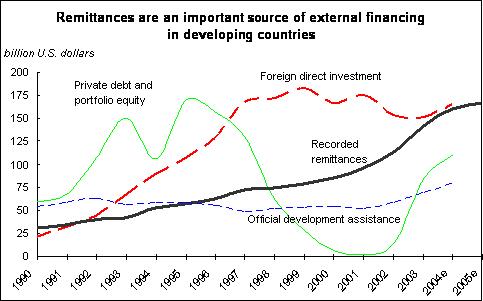
Officially recorded remittances worldwide exceeded US$232 billion in 2005. Of this, developing countries received US$167 billion, more than twice the level of development aid from all sources. The GEP authors suggest that remittances sent through informal channels could add at least 50 percent to the official estimate, making remittances the largest source of external capital in many developing countries.
The countries receiving the most in recorded remittances are India (US$21.7 billion), China (US$21.3 billion), Mexico (US$18.1 billion), France (US$12.7 billion), and the Philippines (US$11.6 billion). Those for which remittances account for the largest proportion of gross domestic product are Tonga (31%), Moldova (27.1%), Lesotho (25.8%), Haiti (24.8%), and Bosnia and Herzegovina (22.5%.
Despite the emphasis on remittances from developed countries, remittances sent from developing countries—the so-called "South-South flows"—represent 30-45 percent of total remittances.
"Migration is truly a global phenomenon," said Dilip Ratha, one of the co-authors of the report. "Many countries, both developed and developing, both send and receive migrants, and both send and receive remittances."
Analysis of household surveys indicates that remittances have been associated with significant declines in poverty (headcounts) in several low-income countries, including Uganda (11 percent), Bangladesh (six percent) and Ghana (five percent). In addition, remittances appear to help households maintain their consumption levels through economic shocks and adversity. They are also associated with increased household investments in education and health, as well as increased entrepreneurship. These conclusions are borne out by findings of a recent World Bank research study, International Migration, Remittances and the Brain Drain, co-edited by Caglar Ozden and Maurice Schiff.
But the fees charged by remittance service providers are often as high as 10-15 percent for small transfers typically made by poor migrants. The GEP urges action to reduce these fees, which are often much higher than the actual cost of carrying out the transactions. The report says increased competition in the remittance transfer market would result in lower fees, thereby increasing the disposable income of poor migrants, as well as their incentives to send more money home.
Reduce remittance transfer costs
Reducing remittance costs would do more to encourage the use of formal remittance channels than will regulation of so-called informal services. While regulation is necessary to curb money laundering and terrorist financing, it must be implemented in a way that does not interfere with the objective of reducing remittance costs.
The GEP recommends increasing access by poor migrants and their families to formal financial services for sending and receiving remittances. This could be done by encouraging the expansion of banking networks, allowing domestic banks in origin countries to operate overseas, providing recognized identification cards to migrants, and facilitating the participation of micro-finance institutions and credit unions in the remittances market.
The report cites experiences of reducing remittance transfer fees in India, the Philippines, and the U.S.-Mexico corridor, as examples for others to follow. These involved government action to open the postal system to increase competition for remittance transfers, issuance of a consular identification card to facilitate opening of bank accounts by Mexican migrants in the U.S., and the use of cell-phone text messaging for remittance transfers, among others.
In addition to raising consumption levels in the migrants' families, the steady stream of foreign exchange that remittances deliver can improve a country's creditworthiness for external borrowing. Where financial institutions can securitize remittance deposits, they can expand access to capital in developing countries and lower borrowing costs.
While encouraging reforms to facilitate an increased flow of remittances, the report opposes efforts by governments to tax remittances and cautions against providing incentives to direct remittances to specific areas or sectors through matching-fund programs. Arguing that these schemes have met with little success in the past, the Bank report advises governments to treat remittances like other private income. Similarly, as private funds, remittances should not be viewed as a substitute for development assistance, the report argues.
"Remittances are hard-earned income that, in most cases, has already been taxed," Bank chief economist Bourguignon said. "They should not be taxed again, and governments should not try to count them as development aid."
(China.org.cn November 17, 2005)