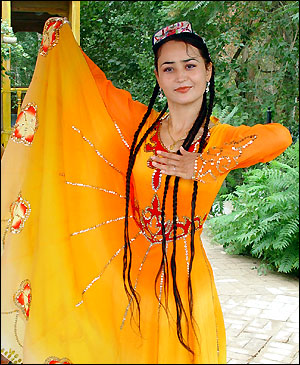
Population: 8,399,393
Major area of distribution: Xinjiang
Language: Uygur
Religion: Islam
Almost all the Uygurs are found in Xinjiang Uygur Autonomous Region which covers more than 1,709,400 square kilometers or approximately one sixth of China's total landmass, and is by far the biggest of the country's regions and provinces. It occupies much of the sparsely-populated northwest.
Besides the Uygur ethnic group, Han, Kazak, Hui, Mongolian, Kirgiz, Tajik, Xibe, Ozbek, Manchu, Daur, Tatar and Russian people also live in Xinjiang. The Uygurs is the largest ethnic group in Xinjiang. They believe in Islam.
The region is bounded by the Altay Mountains in the north, the Pamirs in the west, the Karakoram Mountains, Altun Mountains and Kunlun Mountains in the south. The Tianshan Mountains divide Xinjiang into northern and southern parts with very different climate and landscape. Southern Xinjiang includes the Tarim Basin and the Taklimakan Desert, China's largest, while northern Xinjiang contains the Junggar Basin, where the Karamay Oilfields and the fertile Ili River valley are situated. The Turpan Basin, the hottest and lowest point in China, lies at the eastern end of the Tianshan Mountains. The Tarim, Yarkant, Yurunkax and Qarran rivers irrigate land around the Tarim Basin, while the Ili, Irtish, Ulungur and Manas rivers flow through arable and pastoral areas in northern Xinjiang. Many of the rivers spill into lakes. The Lop Nur, Bosten (Bagrax), Uliungur and Ebinur lakes teem with fish.
Xinjiang's climate is dry and warm in the south, and cold in the north with plenty rainfall and snow. The Uygurs farm areas around the Tarim Basin and the Gobi Desert. Wheat, maize and paddy rice are the region's main grain crops, and cotton is a major cash crop. Since the 1950s, cotton has been grown in the Manas River valley north of 40 degrees latitude. The Tianshan Mountains are rich in coal and iron, the Altay in gold, and the Kunlun in jade. The region also has big deposits of non-ferrous and rare metals and oil, and rich reserves of forests and land open to reclamation.
History
Xinjiang has been part of China since ancient times. The Uygurs, together with other ethnic groups, opened up the region and have had very close economic and cultural ties with people in other parts of the country, particularly central China.
Xinjiang was called simply "Western Region" in ancient times. The Jiaohe ruins, Gaochang ruins, Yangqi Mansion of "A Thousand Houses," Baicheng (Bay) Kizil Thousand Buddha Grottoes, Bozklik Grottoes in Turpan, Kumtula Grottoes in Kuqa and Astana Tombs in Turpan all contain a great wealth of relics from the Western and Eastern Han dynasties (206 BC-AD 220). They bear witness to the efforts of the Uygurs and other ethnic groups in Xinjiang in developing China and its culture.
Zhang Qian, who lived in the second century BC, went to the Western Region as an official envoy in 138 and 119 BC, further strengthening ties between China and central Asia via the "Silk Road." In 60 BC, Emperor Xuan Di of the Western Han Dynasty established the Office of Governor of the Western Region to supervise the "36 states" north and south of the Tianshan Mountains with the westernmost border running through areas east and south of Lake Balkhash and the Pamirs.
During the Wei, Jin, Northern and Southern dynasties (220-581) the Western Reigon was a political dependent of the government in central China. The Wei, Western Jin, Earlier Liang (317-376), Earlier Qin (352-394) and Later Liang (386-403) dynasties all stationed troops and set up administrative bodies there. In 327, Zhang Jun of the Earlier Liang Dynasty set up in Turpan the Gao Chang Prefecture, the first of its kind in the region.
In the mid-seventh century, the Tang Dynasty established the Anxi Governor's Office in Xizhou (present-day Turpan, it later moved to Guizi, present-day Kuqa) to rule areas south and north of the Tianshan Mountains. The superintendent's offices in the Pamirs were all under the jurisdiction of the Anxi Governor's Office. In the meantime, four Anxi towns of important military significance – Guizi, Yutian (present-day Hotan), Shule (present-day Kaxgar) and Suiye (on the southern bank of the Chu River) – were established.
In the early eighth century, the Tang Dynasty added Beiting Governor's Office in Tingzhou (present-day Jimsar). The Beiting and Anxi offices, with an administrative and military system under them, implemented effectively the Tang government's orders.
In the early 13th century, Genghis Khan (1162-1227) appointed a senior official in the region. The Yuan Dynasty (1271-1368) established Bieshibali (present-day areas north of Jimsar) and Alimali (present-day Korgas) provinces. The Hami Military Command was set up during the Ming Dynasty (1368-1644). During the Qing Dynasty (1644-1911) the northern part of the Western Region, namely, north of Irtish River and Zaysan Lake, was under Zuo Fu General's Office in Wuliyasu. The General's Office in Ili exercised power over areas north and south of the Tianshan Mountains, east and south of Lake Balkhash and the Pamirs. Xinjiang was made a province in 1884, the 10th year of the reign of Emperor Guang Xu.
Uygur means "unity" or "alliance." The origin of the ethnic group can be traced back to the Dingling nomads in northern and northwestern China and in areas south of Lake Baikal and between the Irtish River and Lake Balkhash in the third century B.C. Some people maintain that the forefathers of the Uygurs were related to the Hans. The Dingling were later called the Tiele, Tieli, Chile or Gaoche (high wheel). The Yuanhe tribe reigned supreme among the Gaoche tribes during the fifth century A.D., and the Weihe among the Tiele during the seventh century. Several tribes rallied behind the Weihe to resist Turkic oppression.
These ancient Uighur people were finally conquered by Turkic Kirghiz in the mid-ninth century. The majority of the Uighurs, who were scattered over many areas, moved to the Western Region under the Anxi Governor's Office, and areas west of Yutian. Some went to the Tufan principality in western Gansu Province. The Uighurs who settled in the Western Region lived commingled with Turkic nomads in areas north of the Tianshan Mountains and western pasturelands as well as with Hans, who had emigrated there after the Western and Eastern Han dynasties. They intermarried with people in southern Xinjiang and Tibetan, Qidan (Khitan) and Mongol tribes, and evolved into the group now known as the Uygurs.
The Uygurs made rapid socio-economic and cultural progress between the ninth and the 12th centuries. Nomadism gave way to settled farming. Commercial and trade ties with central China began to thrive better than ever before. Through markets, they exchanged horses, jade, frankincense and medicines for iron implements, tea, silk and money. With the feudal system further established, a land and animal owners' class came into being, comprising Uygur khans and Bokes (officials) at all levels. After Islam was introduced to Kaxgar in the late 10th century, it gradually extended its influence to Shache (Yarkant) and Yutian, and later in the 12th century to Kuya and Yanqi, where it replaced Shamanism, Manichae, Jingism (Nestorianism, introduced to China during the Tang Dynasty), Ao'ism (Mazdaism) and Buddhism, which had been popular for hundreds of years. Western Region culture developed quickly, with Uygur, Han, Sanskrit, Cuili and Poluomi languages, calendars and painting styles being used. Two major centers of Uygur culture and literature – Turpan in the north and Kaxgar in the south – came into being. The large number of government documents, religious books and folk stories of this period are important works for students of the Uygur history, language and culture.
In the early 12th century, part of the Qidan tribe moved westward from north-east China under the command of Yeludashi. They toppled the Hala Khanate established by the Uygurs, Geluolu and other Turkic tribes in the 10th century, and founded the Hala Khanate of Qidan (Black Qidan), or Western Liao as it is now referred to by historians. The state of Gao Chang became its vassal state. After the rise of the Mongols, most of Xinjiang became the territory of the Jagatai Khanate. In the meantime, when many Hans were sent to areas either south or north of the Tianshan Mountains to open up waste land, many Uygurs moved to central China. The forefathers of the Uygurs and Huis in Changde and Taoyuan counties in Hunan Province today moved in that exodus. The Uygurs exercised important influence over politics, economy, culture and military affairs. Many were appointed officials by the Yuan court and, under the impacts of the Han culture, some became outstanding politicians, military strategists, writers, historians and translators.
The Uygur areas from Hami in the east to Hotan in the south were unified into a greater feudal separatist Kaxgar Khanate after more than two centuries of separatism and feuding from the late 14th century. As the capital was moved to Yarkant, it was also known as the Yarkant Khanate. Its rulers were still the offspring of Jagatai. During the early Qing period, the Khanate was a tributary of the imperial court and had commercial ties with central China. After periods of unsteady relations with the Ming Dynasty, the links between the Uygurs and ethnic groups in central China became stronger. Gerdan, chief of Dzungaria in northern Xinjiang, toppled the Yarkant Khanate in 1678 and ruled the Uygur area. The Qing army repelled in 1757 (the 22nd year of the reign of Emperor Qian Long) the separatist rebellion by the Dzungarian nobles instigated by the Russian Tsar, and in 1759 smashed the "Batu Khanate" founded by Poluonidu and Huojishan, the Senior and Junior Khawaja, in a separatist attempt.
The Qing government introduced a system of local military command offices in Xinjiang. It appointed the General in Ili as the highest Western Regional Governor of administrative and military affairs over northern and southern Xinjiang and the parts of Central Asia under Qing influence and the Kazak and Blut (Kirgiz) tribes. For local government, a system of prefectures and counties was introduced.
The imperial court began to appoint and remove local officials rather than allowing them to pass on their titles to their children. This weakened to some degree the local feudal system. The court also encouraged the opening up of waste land by garrison troops and local peasants, the promotion of commerce and the reduction of taxation, which were important steps in the social development of Uygur areas.
Xinjiang was completely under Qing Dynasty rule after the mid-18th century. Although political reforms had limited the political and economic privileges of the feudal Bokes (lords), and taxation was slightly lower, the common ethnic people's living standards did not change significantly for the better. The Qing officials, through local Bokes, exacted taxes even on "garden trees." The Bokes expanded ownership on land and serfs, controlled water resources and manipulated food grain prices for profit.
Harsh feudal rule and exploitation gave rise to the six-month-long Wushi (Uqturpan) uprising in 1765, the first armed rebellion by the Uygur people against feudalism. With the aim of preserving their rule and getting rid of Qing control, Uygur feudal owners made use of struggles between religious factions to whip up nationalism and cover up the worsening class contradictions. Zhangger, grandson of the Senior Khawaja, a representative of those owners, under the banner of religion and armed with British-supplied weapons, harassed southern Xinjiang many times from 1820 to 1828, but failed to win military victory.
Uprisings and foreign intervention
Not long after the outbreak of the Opium War, the Uygurs and Huis in Kuqa, influenced by rebellions of the Taiping Heavenly Kingdom and the Nian Army uprisings by ethnic minority peasants in Yunnan, Shaanxi and Gansu provinces, launched an armed uprising in 1864. People in Urumqi, Shache (Yarkant), Ili, Barkol, Qitai, Hami, Mori, Jimsar and Changji responded. Uprisings against the Qing court swept Xinjiang, and several separatist regimes came into being. However, a handful of national and religious upper elements usurped the fruits of the uprisings under the cloak of "ethnic interest" and "religion," and became self-styled kings or khans. The warfare that ensued among them brought still greater catastrophes to the local people.
Britain fostered Yukub Beg, the General Commander of the Kokand Khanate in 1865, who invaded Xinjiang and established the Zhedsar Khanate (Seven-City Khanate). Yukub Beg was a tool in the hands of Britain and Tsarist Russia, who wanted to split Xinjiang. He exercised cruel rule and, in the name of Allah, killed 40,000 non-Muslims in southern Xinjiang. His persecution was also extended to Islamic believers, who were tried at unfair "religious courts." The local people had to shoulder the war burdens, supplying warring factions with food grain, fuel, vehicles and draught animals, and the local economy suffered catastrophic damage. Bankrupt peasants fled, and some had to sell their children for a living. The slave trade boomed at local bazaars.
To preserve Russia's vested interest and maintain an equilibrium in influence with Britain in Central Asia, the Tsar, behind the back of the Qing Court, signed illegal commercial and trade treaties with Yukub Beg. Russia claimed that it could not "sit idle" while there were uprisings in the provinces in western China, and in the name of "recovery and defense upon request," it sent troops to occupy Ili in 1871 and started a 10-year period of colonial rule. The Russian troops forced people of the Uygur, Kazak, Hui, Mongolian and Xibe tribes into designated zones in a "divide and rule" policy. Many Uygurs had to flee their home towns, and moved to Huicheng and Dongshan.
It was in the interest of all ethnic groups to smash the Yukub Beg regime and recover Ili. So many local people supported the Qing troops when they overthrew Yukub Beg and recovered Xinjiang in 1877. However, not long after the Qing government had signed the "Sino-Russian Treaty of Peking" and the "Tahcheng Protocol on the Delimitation of the Sino-Russian Border," whereby China was compelled to cede 440,000 square kilometers of land to Russia, the Qing Court again concluded the "Ili Treaty" with Russia in 1881. Although China recovered Ili, it lost another 70,000 square kilometers of territory west of the Korgas River, and was charged nine million roubles compensation. On the eve of its withdrawal from Ili, Tsarist Russia coerced more than 10,000 Uygur, Hui, Mongolian, Kazak and Kirgiz people to move to Russia. Farmland, irrigation facilities, houses and orchards were devastated and food grain and animals looted. Five of nine cities in Ili became virtually ruins, and the Uygurs in the nine townships on the right bank of the Ili River were reduced to poverty.
The Qing government decided to make the Western Region – formerly ruled by the general stationed in Ili – a province named Xinjiang, a step of important significance for local development and the strengthening of the north-west border defense against imperialist aggression. Ties between the area and central China became closer, and there was greater unity between the Uygurs and other ethnic groups in the common struggle against imperialism and feudalism.
After the Revolution of 1911 which overthrew the Qing Dynasty, Qing rule was replaced by feudal warlords. Sheng Shicai, who claimed to be progressive, usurped power in Xinjiang in the "April 12" coup of 1933.
In the same year, Britain encouraged Mohamed Imin, who dreamed of a greater Turkey, to found the Hotan Islamic Republic, and Maula Shabitida, an advocate of greater Islam, to set up the East Turkistan Islamic Republic. Japanese imperialism in 1937 masterminded the plots by Mamti and Raolebas to form an "independent" Islamic state, and Mamti, in collaboration with Mahushan, rebelled. However, all these separatist efforts failed.
Contemporary history
In 1933, when China was at a crucial point in history, the Chinese Communist Party began revolutionary activities in Xinjiang aimed at peace, democracy and progress. Sheng Shicai had to take some progressive steps, and declared six major policies -- anti-imperialism, amity with the Soviet Union, national equality, honest government, peace and national reconstruction. In the same year, the "Anti-Imperialist Association of the People of Xinjiang" was formed, and the journal, "Anti-Imperialist Front," was published. Part of the Chinese Workers' and Peasants' Red Army went to Xinjiang in 1937. Later Sheng Shicai turned to the Kuomintang, persecuting the Communists, progressive people, patriotic youth and workers.
The Kuomintang began to rule Xinjiang in 1944, forcing sharper contradictions on the Uygurs and other ethnic groups. It exacted dozens of taxes under all kinds of pretexts. One example was the taxation on land. An average peasant had to pay well over 15 percent of annual income for it. The amount of taxes in terms of money was eight times the sum in 1937. Local industry and commerce virtually went bankrupt, and the situation for rural Uygurs was even worse.
Uprisings took place in Ili, Tacheng and Altay to oppose Kuomintang rule. They served to accelerate the liberation of the region in the national liberation war.
Tao Zhiyue, the Commandant of the Kuomintang Xinjiang Garrison, and Burhan Shahidi, Chairman of the Kuomintang Xinjiang Provincial Government, accepted Chinese Communist Party's peace terms, and revolted against the Kuomintang government in Nanjing, and Xinjiang was peacefully liberated in October, 1949.
Post-liberation development
The Xinjiang Uygur Autonomous Region was formally established on October 1, 1955. Five autonomous prefectures and six autonomous counties were set up in the following months. Ethnic minority autonomy became a reality.
Customs and habits
In the past, many poor Uygur farmers lived on a diet of narrow-leaved oleaster and dried apricot and peach, mulberry and grain porridge. Now, wheat flour, rice and maize are the staple foods. Uygurs in some areas like milk tea with baked maize or wheat cakes. Some are made by mixing flour with sugar, eggs, butter or meat and are delicious. Paluo (sweet rice), cooked with mutton, sheep fat, carrots, raisins, onions and rice, is an important festival food for guests.
The Uygurs' cotton growing and cotton yarn spinning industry has a long history. Working people usually wear cotton cloth garments. Men sport a long gown called a qiapan, which opens on the right and has a slanted collar. It is buttonless and is bound by a long square cloth band around the waist. Women wear broad-sleeved dresses and black waist coats with buttons sewn on the front. Some now like to wear Western-style suits and skirts. The Uygurs, old and young, men and women, like to wear a small cap with four pointed corners, embroidered with black and white or colored silk threads in traditional Uygur designs. The women's favorite decorations include earrings, bracelets and necklaces. Some paint their eyebrows and fingernails on grand festive occasions. Girls in the past combed their hair into a dozen pigtails, and regarded long hair as part of female beauty. After marriage, they usually wear two pigtails with loose ends, decorated on the head with a crescent-shaped comb. Some tuck up their pigtails into a bun.
Over the centuries, many mosques, mazas (Uygur complexes, nobles' tombs), theological seminaries and religious courts were set up in Uygur areas. Over the past few hundred years, religion has greatly influenced economic, judicial and educational affairs and the Uygur family and matrimonial system. Some of the rich people made use of religious rules to marry more than one wife, and had the right to divorce them at any time. The marriage of the ordinary Uygurs was mostly arranged by the parents. Male chauvinism was practiced in the family, and Uygur women, humiliated and with nobody to turn to, often retreated into prayer.
After 1949, feudal religious privileges were abolished, and religion was taken out of the control of the reactionary ruling class, and became a matter of individual conscience. As science and knowledge spread, many of the old feudalistic religious habits lost popularity. People can now decide for themselves whether the Sawm should be observed during Ramadan, how many naimazi (services) should be performed in a day and whether women in the street should wear veils.
As these matters do not affect normal religious belief, the Uygurs are beginning to enjoy a more genuine religious freedom. The family, marriage and property are under the protection of the law, and Uygur women enjoy equality with men. Many are now working alongside men in modern industries.
There are now more than a dozen million Moslems in the country, compared with eight million in the early post-1949 period. In 1953, the Chinese Islamic Association was established with Burhan Shahidi as its chairman. More than seven million people in Xinjiang believe in Islam, accounting for well over half of the national total. In the mid-1080s, there were 15,800 religious professionals, about 2,000 of whom were either deputies to the People's Congress or the Chinese People's Political Consultative Conference at various levels, or worked in the regional or county branches of the Chinese Islamic Association. The region now boasts a total of 15,500 mosques or prayer centers, or one for almost every Moslem village.
Culture since the mid-20th century
Uygur culture and art, which have a long and rich tradition, has flourished. Uygur literature is very rich in style and subject matter. Many folk tales, parables, comedies, poems and proverbs praise the courage, wisdom and kindness of the ordinary people, while satirizing the greed, cruelty and foolishness of the exploiting classes. For instance, "The Tales of Afandi" contain stinging satire about the Bayis and Imams who bully the people.
Much of the written Uygur literature has been passed down from the 11th century, such as the epic "Kutadolu Biliq" (Blessings and Wisdom) by Yusuf Hass Hajib, and The Turkic Dictionary by Mohamu Kashgar, which are important works for students of ancient Uygur history, culture and language. More modern works include Maulabilalibin Maulayusuf's Wars on the Chinese Land, an epic describing the 1864 struggle of the Uygurs in Ili against the Qing government. Mutalifu, the patriotic and revolutionary poet, composed poems such as "Chinese Guerrillas," "Militant Girls" and "Love and Hatred" during the Anti-Japanese War. After 19949, much work has been done to collect, compile and publish classic and folk Uygur literature.
The Uygurs are excellent at dancing. The "12 Mukams" (opera) is an epic comprising more than 340 classic songs and folk dances. After liberation, this musical treasure, which was on the verge of being lost, was collected, studied and recorded. The "Daolang Mukams," popular in Korla, Bachu (Maralwexi), Markit and Ruoqiang (Qarkilik), is another suite with distinct Uygur flavor.
There is a wide variety of plucked, wind and percussion Uygur musical instruments, including the dutar, strummed rawap and dap. The first two are instruments with a clear and crisp tone for solo and orchestral performances. The dap is a sheepskin tambourine with many small iron rings attached to the rim. It is used to accompany dancing.
The Uygur dances, such as the "Bowls-on-Head Dance," "Drum Dance," "Iron Ring Dance" and "Puta Dance," feature light, graceful and quick-swinging choreography movements. The "Sainaim Dance" is the most popular, while the "Duolang Dance," sometimes referred to as a flower of Uygur folk culture, brims over with vitality. It depicts the hunting activities of the ancient people of Markit. The movements portray strength, wildness and enthusiasm. The "Nazilkum," popular in Turpan, Shanshan and Hami, fully reflects the Uygurs' optimism and gift for humor.
(China.org.cn June 21, 2005)