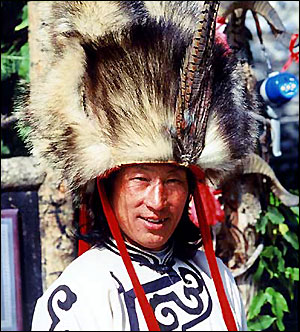
Population: 306,072
Major area of distribution: Sichuan
Language: Qiang
Religion: Animism
The Qiang ethnic minority has a population of 306,072 who mostly dwell in hilly areas, crisscrossed by rivers and streams, in the Maowen Qiang Autonomous Prefecture in Sichuan Province. A small number live with Tibetan, Han and Hui ethnic groups in such localities as Wenchuan, Dali, Heishui and Songpan.
They occupy a fertile land of mild climate and adequate rain. The mountain slopes are natural pastures. The area abounds in precious Chinese caterpillar fungus, bulb of fritillary, antlers, musk and bear's gallbladders, which are used for medicine. Deep in the forests are such rare animals as giant pandas, golden monkeys and flying foxes. The region is also rich in iron, coal, crystal, mica and plaster stone deposits.
History
"Qiang" was a name given by ancient Hans to the nomadic people in west China. The Qiangs were not a single distinctive ethnic group then. According to historical records, a clan group made their homes in what is today's Sichuan Province. The Han Dynasty (206 BC-AD 220) court in the 2nd century had set up an administrative prefecture for the area. During AD 600 to 900 when the Tibetan Regime gradually expanded its rule over the region, some Qiangs were assimilated by the Tibetans and others by the Hans, leaving a small number unassimilated. These developed into the distinctive ethnic group of today.
The Qiangs do not have a written script of their own. They speak a language belonging to the Tibetan-Myanmese language family of the Chinese-Tibetan system. Owing to their close contact with the Han people, many Qiang people speak Chinese, which is also the written form for this ethnic group.
The Qiang and Han peoples have had time-honored close political, economic and cultural ties. Administratively, Han courts from the Qin, Han, Sui and Tang dynasties down to the Ming Dynasty all had political units in the Qiang-occupied areas. In the early Qing Dynasty (1644-1911), the system of appointing local hereditary headmen by the central authority to rule over the Qiangs gave way to officials dispatched from the court. The central administrative system helped enhance the ties between the Qiang and Han ethnic groups. With their horses, medicinal herbs and other native produce, the Qiangs used to barter farm implements and daily necessities from the Hans. Mutual support and help stimulated the social and economic development of Qiang society.
For a long period before China’s national liberation in 1949, the Qiangs lived in primitive conditions marked by slash and burn farming. A feudal landlord economy dominated production. Landlords and rich peasants, who accounted for only 8 percent of the population, were in possession of 43 percent of the cultivated land. Poor peasants and hired farm hands, accounting for 43 percent of the population, had only 16 percent of the land. Many poor peasants lost their land due to heavy rent coupled with usury. They became hired laborers, wandering from place to place to make a living.
Life style
The Qiangs dress themselves simply but beautifully. Men and women alike wear gowns made of gunny cloth, cotton and silk with sleeveless sheep's wool jackets. They like to bind their hair and legs. Women's clothing is laced and the collars are decorated with plum-shaped silver ornaments. They wear sharp-pointed and embroidered shoes, embroidered girdles and earrings, neck rings, hairpins and silver badges.
Millet, highland barley, potatoes, winter wheat and buckwheat make up their main staple foods. The Qiangs drink a great deal of wine and smoke orchid leaves.
They live in blockhouses made of piled up stones of different sizes. Unique in style, solid and practical, these houses are two or three stories high. The first floor is for livestock and poultry, the second retained as bedrooms and the third for grain storage. The Qiang people are skilled in opening up roads on rocky cliffs and erecting bamboo bridges over swift rivers. The bamboo chain bridges they built, laid with boards, stretch up to 100 meters with no nails and piers being used. Some of the Qiangs are excellent masons and are good at digging wells. During slack farming seasons they go to neighboring places to do chiseling and digging. Their skills are highly acclaimed.
Marriages, mainly monogamous, were arranged by parents in the past. Usually, the wives were several years older than their husbands. It was common for cousins to marry and for bridegrooms to live with their wives' families. And it still is not unusual for brides to live in their parents' houses within a year or so after marriage. In Qiang society, younger brothers could make their widowed sister-in-laws their wives and elder brothers could marry the widows of their younger brothers. Such habits have been gradually discarded since liberation.
Most Qiangs were believers of Animism, except for those who lived near Tibetan communities and were followers of Lamaism. The Qiangs worshipped white stones placed on roofs as the "Heavenly God."
The Qiang people have created a unique culture and arts and crafts. The clever and deft Qiang women can do embroidery and drawnwork extemporaneously without designs. The Qiangs are good singers and dancers. "Wine song," "plate song," "mountain song" and "leather drum" dances with accompaniment of gongs, tambourines, sonas and bamboo flutes are popular.
New life
The Qiang area was liberated in January 1950. In July, 1958 the Maowen Qiang Autonomous County was established. By relying on collective efforts, they carried out large-scale capital construction projects in their rocky region, where productivity used to be low because of backward local conditions and the shortage of men. Among the projects are tractor stations, reservoirs, hydroelectric stations and pumping and drainage facilities. Now more farm machinery is used and scientific farming methods have been introduced. Grain output increases every year.
In the Qiang area, which had no industry and highways before, enterprises have sprung up and two concrete and 28 steel-chain bridges have been built over the Minjiang River. The area's total highway mileage has reached 260 kilometers. A postal route network covers every corner of the area.
The over 20 primary and nine middle schools that have been built in post-1949 years enroll over more than 80 percent of school-age children. Thanks to the efforts of medical workers, mass screening and treatment has brought black fever and hook worm, two major epidemic diseases, under control. New delivery methods have greatly raised the infant survival rate and the Qiang population has risen markedly.
The Qiang area is dotted with small hydroelectric power stations. Electricity reaches almost all households and is used in processing farm and sideline produce and in mining and industry. People's life has been enriched by village film projection teams and a broadcasting network.
(China.org.cn June 21, 2005)