Recycling used things becomes trendy and handy in China
 0 Comment(s)
 Print
Print E-mail Beijing Review, April 25, 2021


Wang Yewen, a 32-year-old company staff member, recently moved into a new apartment in Beijing. The moving process proved torture, as she had too much stuff she didn't even realize existed. Fortunately, she got a helping hand from Baijingyu, an online recycling platform. Using an applet in Alipay, one of China's most frequently used mobile wallets, she arranged for a pickup service and an employee then came to her door to collect all the things she wouldn't use anymore. The entire process was free of charge.
Not only clothes, but also books and smart devices can be collected. On their Baijingyu personal account, users can check how many kilograms of old stuff they have already put into recycling.
"It was my second time using the platform and I found it both very convenient and fulfilling given I was doing my little bit to protect the Earth," Wang told Beijing Review.
Online recycling
According to the Baijingyu applet's homepage, recycled textiles are managed in many ways. One method is to reprocess them in an environmentally friendly way into thermal and acoustic insulation materials or other textile products. The second one is to donate relatively new items, usually children's winter clothing, to China's poorer mountainous areas; the third approach is to deliver relatively new summer wear to impoverished or war-torn countries in Africa, Southeast Asia, and other parts of the world.
However, the demand for second-hand clothes from underdeveloped regions in China is decreasing due to the successes achieved in poverty alleviation in recent years. Zhou Dan, the person in charge of Baijingyu's marketing and business operations, said that the company is using some of its income to purchase books, stationery, and other things that the children in less developed regions have a pressing need for.
Moreover, some recycled clothes, after going through disinfection treatment and other processes, will be exported and sold at second-hand markets in countries where such markets are booming because of insufficient local textile production.
In cooperation with famous apparel and footwear enterprises like Li Ning, Baijingyu helps customers accept clothing made of recycled materials by explaining to them that such materials are more environmentally friendly. Also, Baijingyu's recycling bins are placed across partner shopping malls and customers who donate their clothes there can get shopping credits for doing so.
"Hopefully, such practices can help foster new consumer habits and encourage more of them to pay for environmental protection," Zhou told Beijing Review.
Zhou explained that China's recycling business is on the rise thanks to a combination of factors such as urbanization, the development of e-commerce, the relatively low costs of delivery services and the maturity of digital technology. Before 2017, those who used recycling services more frequently were young people across the nation's metropolises like Beijing, Shanghai, Guangzhou, and Shenzhen. Today, more age groups including those aged over 55 have been introduced to such services by their younger family members, colleagues and friends. The share of Baijingyu users aged 35-55 rose to over 20 percent in 2020, from a mere 5 percent only a few years ago.
Baijingyu on Alipay isn't the only platform out there; many similar-minded programs are making their foray into recycling in China. According to data released in June 2020, 80 percent of recycling enterprises had operated applets through Alipay, with their total number of daily active users surging by six times compared with earlier months in this year when COVID-19 was rampant.
Recycling offline
Changchun, capital of Jilin Province, has witnessed the sprouting of a special type of stores recently. Instead of using money to buy goods, people can swap their used items for things like condiments and food ingredients. Inside one such store, a poster on the wall features the amount of carbon dioxide emissions that can be reduced for every recycled item such as a cardboard box or a piece of clothing.
Residents can also take anything they no longer have need for to the store to trade them for bonus points, and then use these to redeem goods, according to Qu Dan, the store manager. She added that this approach also helps raise people's environmental awareness. The special stores were founded by Jilin Rongxinkun Environmental Technology Co. Ltd., a company engaging in the development of environmental technology, as well as recycling and garbage disposal.
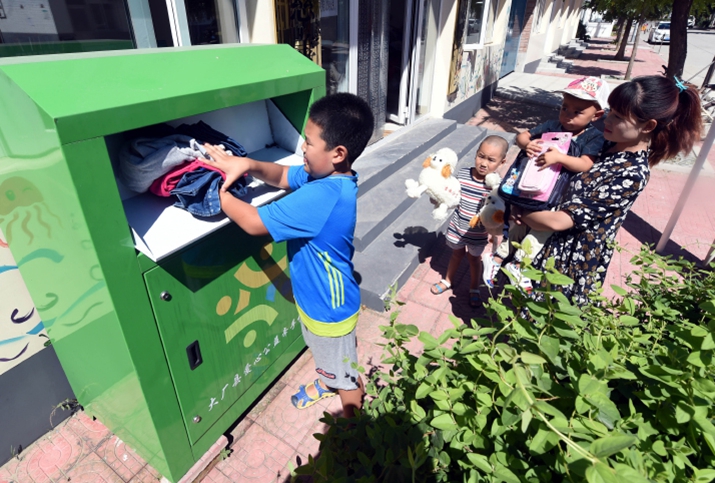
At residential neighborhoods in some cities across the country, large green clothing-recycling containers are in place to receive donated items from residents. "Many of what I've put in the containers are relatively new clothes, and I'm happy they are going to those who need them the most," said Liu Xinyu, a resident of Beijing, adding that before the containers were introduced, she had always wanted to donate clothing to those impoverished, but she didn't know where to deliver them. And even when she did manage to obtain an address, the high delivery fees were discouraging. So ultimately the clothes ended up in the garbage bin.
Many of the programs to install the recycle bins are organized by community offices, environmental companies or charities. After the clothes are collected, they will be sorted into "reusable" and "non-reusable" piles. The former will be washed, disinfected, and delivered to people in need, whereas the latter will be disposed of or reprocessed and recycled. According to Zhao Chunyu, manager of the textile recycle bin project of Guizhou Water Drop Charity Home, a philanthropic organization based in Guiyang, Guizhou Province, over 2,000 containers are available for collecting donations across the city. In 2020 alone, a total of 736.96 tons of used clothing or other textiles were recycled through these containers.
"All donations will be announced on our website so that donors will know exactly where their items went," Zhao told Guiyang Daily.
Additionally, the recycling rate of large household appliances is also seeing much improvement. According to the National Development and Reform Commission (NDRC), 100 million to 120 million pieces of home appliance are discarded in China each year, and this number is expected to increase at an average annual rate of 20 percent.
In May 2020, seven government departments, including the NDRC and the Ministry of Ecology and Environment, jointly issued an implementation plan on improving the recycling of old household appliances. In addition to improving online and offline recycling, the document encourages waste processing companies to upgrade their technology and equipment and increase the added value of processed products.
The blueprint further urges consumers to use home appliances in a safe and environmentally friendly way, such as promptly replacing old ones that have exceeded their service life as they will become energy-consuming and unsafe to use.
Manufacturers, sales companies, and e-commerce platforms are motivated to organize activities such as anniversary celebrations and shopping festivals and offer discounts to encourage trading of old home appliances for new ones.
Mobile phone waste, too, has become a public concern as China has a huge number of mobile phones discarded every year. According to the Ministry of Industry and Information Technology, from January to February 2021, China's mobile phone output reached 210 million, an increase of 49.2 percent year on year. Some users will abandon their cellphones even though the devices still function well, just to buy the latest model.
Some old electronic devices are sold on second-hand markets. Statistics of Aihuishou, a Shanghai-based online-to-offline platform founded in 2011 offering electronic product recycle and replacement services, show that the company, with 140 stores nationwide, trades about 20 million second-hand electronic devices annually.
Privacy is a major concern for people wanting to dispose of their electronic devices. After collecting a device from the seller, technicians will help the seller erase all data for free to protect consumer privacy. "By repeatedly erasing and re-writing, user data will be thoroughly deleted," said Zheng Lantao, manager of an Aihuishou chain store in Suzhou, Jiangsu Province.
According to telecommunication expert Fu Liang, recycling second-hand electronic products is imperative for environmental protection and resource conservation. Fu suggested that all relevant departments enhance the transparency of their recycling methods as to promote the industry's healthy and orderly development.


