Poor no more
- Tan Weiping
 0 Comment(s)
 Print
Print E-mail China Today, April 2, 2020


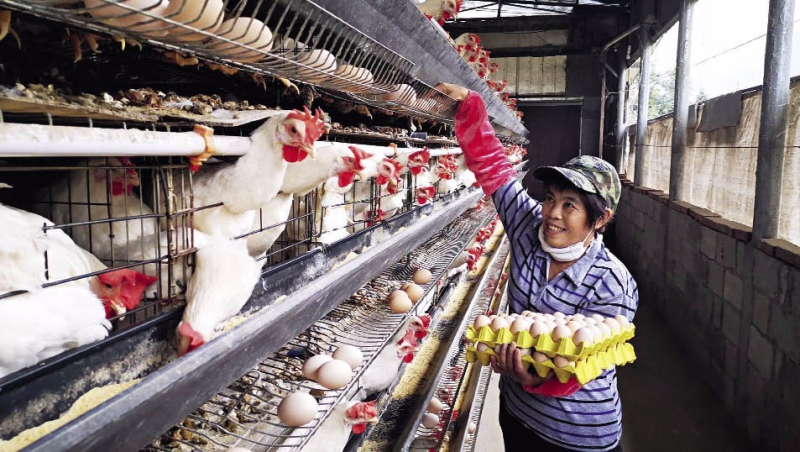
From relief measures for the poorest to development-oriented poverty reduction, and further to targeted poverty reduction, China has embarked on a path specifically dedicated to poverty alleviation and development. Since 2013, the strategy of targeted poverty alleviation has demonstrated its effectiveness, so that the country will very probably reach its objective of completely eradicating absolute poverty by the end of 2020. At the same time, China actively participates in international exchange and cooperation to advance the global fight against poverty.
Three stages of China's fight against poverty
The fight against poverty in China has gone through three distinct stages.
In the first stage, China sought to resolve the problem of general rural poverty through institutional reform (1949-1978). Reform of the rural land system helped to remove the institutional obstacles, which had led to a shortage of land for farmers. Meanwhile, the living conditions of rural dwellers improved considerably thanks to the investment in rural infrastructure, the development of education and health services, the spread of agricultural technologies, and the establishment of a social security system. During this stage, total grain production increased 1.69-fold, the infant mortality rate dropped by 75 percent, life expectancy extended by almost 30 years, and the proportion of the rural population living below the breadline was halved.
The second stage began in 1978 and lasted till 2012, when poverty relief and development were closely integrated into national strategies, and regional efforts to reduce poverty proved to be remarkably effective. China promulgated and implemented the Seven-Year Priority Poverty Alleviation Program and two outlines for development-oriented poverty reduction for China's rural areas (first for the 2001-2010 period, and the second for the 2011-2020 period). The government also established a development-oriented poverty reduction policy, defined the poor districts and the extremely poor contiguous areas, and developed a four-tier system (from central to district), forming a coordinating mechanism for developing infrastructure. This infrastructure involved agriculture, water conservancy, transportation, electricity, and communications, along with social development sectors including science and technology, education, health, and culture. A large-scale planned and organized campaign has thus been promoted to fight poverty at a national strategic level.
The third stage started with the 18th National Congress of the Communist Party of China (CPC) in 2012, which ushered in a new era of poverty campaign characterized by targeted approaches. Considering the decisive fight against poverty as a fundamental task and a flagship indicator for the integral building of a moderately prosperous society, the CPC Central Committee, with President Xi Jinping at its core, has committed to eradicating extreme poverty as a whole by 2020. To do this, the country has provided targeted assistance to the poor, involving a case-by-case examination which has been organized around measures targeted and oriented towards sustainable development, thus eliminating poverty at its root. Through this policy, China has achieved results unparalleled in the history of poverty alleviation at the national level and enabled more people to shake off poverty than any other country.
Verifying policy and measures in practice
By current standards, the rural poverty rate in China fell from 97.5 percent in 1978 to 1.7 percent in 2018. The number of rural poor fell from 770 million to 16.6 million.
Since implementing the targeted poverty eradication strategy, China has achieved its highest results after it started the fight against poverty. More than 80 million people were brought out of poverty in just six years, averaging about 13 million people each year. At the end of 2018, of the 832 poor counties across the country, 436 said goodbye to misery, and the number of poor villages registered and documented dropped from 128,000 in 2013, to 26,000 at the end of 2018.
Thanks to the measures taken, the level of income among rural residents has skyrocketed. According to statistics (see graph), the disposable income per rural resident in poor areas in 2018 reached RMB 10,371, 1.7 times that of 2013. From 2013 to 2018, income grew by an average of 12.1 percent. After deducting the price factor, this average annual growth rate was 10 percent, a real growth rate of 2.3 percentage points higher than the national average for rural areas.
In 2018, the per capita disposable income of rural dwellers living in disadvantaged areas was 71 percent of the average recorded in other rural areas of the country, an increase of 8.9 percentage points compared to 2012. Thus the income gap between these less-favored areas and other rural areas in China continues to shrink.
The level of infrastructure and public services in poor areas has improved significantly. In disadvantaged areas, the fight against poverty is integrated into their overall socio-economic development strategies. Investment in infrastructure and public services has increased significantly; development capacity has been considerably strengthened; the industries having distinctive local features and advantages have developed rapidly; the natural environment has improved substantially; and the quality of life for the poor has steadily improved.
By 2017, 98.5 percent of the villages in poor areas had been connected to the telephone network, 5.2 percentage points more than in 2013; 86.5 percent had access to cable television, 15.8 percentage points more than in 2013; and 71 percent benefited from a broadband Internet connection, 29.5 percentage points more than in 2013. Regarding transport, 81.1 percent of villages had been connected to paved roads, and 51.2 percent had shuttle services, a growth of 21.2 percentage points and 12.4 percentage points respectively from 2013.
The institutional system for tackling poverty has improved considerably. The strategy of taking targeted measures in poverty alleviation involves a complete set of institutional planning, for example, setting clear objectives, establishing individual files for each registered poor family, creating implementation plans, and developing rules and mechanisms related to responsibility, policy, investment, assistance, mobilization, supervision and evaluation.
In terms of responsibility, China has tried to keep the leaders of each level within the Party and government in poor districts stable throughout the campaign against poverty. In this context, the Party chiefs at the five levels (province, city, county, town, and administrative village) can coordinate their actions to fulfill their respective responsibilities in the fight against poverty.
As for policies, the State Council published the 13th Five-Year Plan for the decisive fight against poverty. The central authorities and various state departments have also issued enforcement policies or programs. All local authorities have published and updated a series of related documents. Many targeted measures therefore are in place to address long-standing and difficult problems.
Meanwhile, various sources of investment have been pooled, including special budgetary funds for poverty reduction at central and provincial levels and support from the financial sector.
In addition, a total of 775,000 Party and government officials and employees have been selected across the country to work in poor villages for one to three years. The Organization Department of the CPC Central Committee alone assigned 188,000 competent officials to serve as first secretaries in underprivileged villages and villages with weak Party organizations, in order to play a leading role in the poverty reduction campaign.
Collaboration on poverty alleviation between eastern and western regions has extended to cover all the 30 ethnic autonomous prefectures in the country. A total of 320 departments and institutions at the central level are assisting 592 poor counties; and the army and the armed police have been providing more than 2,000 disadvantaged villages with support and assistance.
Supervision has also been in place to ensure the smooth progress in poverty alleviation. Inspection visits undertaken by the central authorities have highlighted the importance of the fight against poverty. To ensure effective implementation of poverty alleviation policies, the central committees of eight non-Communist parties took the supervision work in eight provinces and regions with a large number of poor people and a high poverty rate. Poverty alleviation authorities have set up a hotline for whistleblowing. All-round cooperation has also been strengthened between various supervisory forces including the disciplinary inspection and supervision departments, the audit and financial departments, the media and the public.
The central government has published measures to assess the performance of provincial Party and government authorities in the fight against poverty. The State Council Leading Group Office of Poverty Alleviation and Development has been organizing the annual evaluation from 2016 to 2020. The content of what is examined mainly includes the results achieved, precise identification of the poor, targeted assistance, and the use of funds.
Accelerating global poverty reduction
Since its reform and opening-up started, China has implemented the poverty alleviation and development strategy in an organized, planned, and large-scale manner. It has become the first developing country to reach its poverty reduction target, a part of the UN Millennium Development Goals, contributing to the eradication of poverty in the world by more than 70 percent. By 2020, all poor people by existing Chinese standards are expected to be able to lift themselves out of poverty. China will therefore provide a historic solution to the problem of absolute poverty, reaching the goal of combating poverty enshrined in the United Nations 2030 Agenda for Sustainable Development 10 years in advance. In doing so, it will breathe new life into the global battle against poverty and share its wisdom and solution about poverty alleviation with the world.
Tan Weiping is deputy director general of the International Poverty Reduction Center in China.


