Share:

An African delegation comprising representatives from six countries including Mali and Rwanda visited Jinjiang, China's Fujian Province from Dec. 10 to 11. The visit allowed the delegation to learn about the city's strengths in industrial manufacturing, laying a solid foundation for future economic and trade cooperation. It serves as a great enabler for future efficient access of Jinjiang's high-quality goods to African markets.

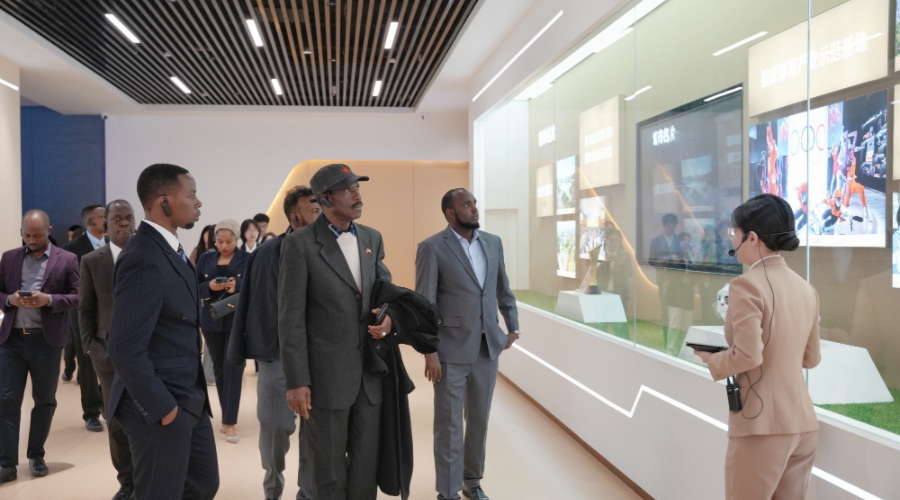
The delegation learns about Jinjiang's industrial and economic development at the Jinjiang Experience Hall, Dec. 10, 2025. [Photo provided to China.org.cn]
During the visit, the delegation gained a comprehensive understanding of the development of Jinjiang's industrial clusters. They visited a series of sites including the Jinjiang Experience Hall, the Global Footwear, Apparel and Textile Supply Chain Innovation Center, the Global Food Supply Chain Center, as well as a number of intelligent manufacturing enterprises specializing in machinery, footwear and apparel.
The delegation focused on Jinjiang's urban development history, the innovation and path of its footwear and apparel industry, the distinctive features of Minnan culture, and the achievements of its global supply chain layout.

Yoro Diallo, former first counselor of the Embassy of the Republic of Mali to Beijing and senior researcher and executive director of the Centre for Francophone Studies at Zhejiang Normal University, looks over product catalogs at the Global Footwear, Apparel and Textile Supply Chain Innovation Center in Jinjiang, Fujian, Dec. 10, 2025.[Photo provided to China.org.cn]
Jinjiang has always adhered to the real economy as its foundation. According to the Jinjiang Municipal Government, Jinjiang has nurtured over 330,000 market entities, more than 100,000 private enterprises and 53 listed companies. It holds 16 regional brands and 46 of China's most well-known trademarks.
At present, Jinjiang has formed seven industrial clusters, characterized by their multi faceted nature. Footwear, apparel and textiles are most apparent with the footwear and apparel industry exceeding a scale of 300 billion yuan. The textile industry has surpassed 100 billion yuan. Meanwhile, the city has built several supply chain innovation centers covering the global footwear, apparel, textiles, umbrellas and food sectors.

The delegation visits Jingong Machinery Co., Ltd. in Jinjiang, Fujian, Dec. 10, 2025. [Photo provided to China.org.cn]
Relying on reform and innovation, Jinjiang has promoted the in-depth integration of the innovation chain, industrial chain, capital chain and talent chain. It has accelerated the transformation from a traditional manufacturing base to a global supply chain and trade center.
By optimizing the business environment, building innovation platforms and attracting high-caliber talents, Jinjiang has continuously stimulated market vitality. The city now ranks 4th in China in terms of basic competitiveness of county economies, and 3rd in the comprehensive development index.
Jinjiang's practices have demonstrated that the strong vitality and contemporary value of the "Jinjiang Experience." These strengths have also become the core appeal for the African delegation to seek cooperation here, laying the groundwork for establishing economic and trade cooperation channels between Jinjiang and African countries, and facilitating the efficient integration of Jinjiang's quality products into the African market.


 京公網(wǎng)安備 11010802027341號(hào)